 ultimate-guide
Peptide Purity Levels for Antibody Production: 2026 Guide
Table of Contents
- Peptide Purity Levels for Antibody Production: What Actually Matters
- Peptide Purity Requirements for Antibody Generation
- How Purity Shapes the Immune Response and Antibody Quality
- Crude Versus Purified Peptides for Antibody Production
- Peptide Purity Testing by HPLC and Mass Spectrometry
- Reading a Peptide Certificate of Analysis for Purity
- Common Mistakes When Selecting Purity Levels
- Conclusion
- Frequently Asked Questions
Last Updated: 7 October 2026
Peptide Purity Levels for Antibody Production: What Actually Matters
Peptide purity levels for antibody production determine whether an immunisation succeeds or quietly wastes months of work. We supply research peptides with batch-specific Certificates of Analysis precisely because this single specification decides how much of your antigen actually reaches the immune system intact.
Peptide purity is the proportion of the total peptide content in a sample that consists of the intended full-length sequence, expressed as a percentage from chromatographic analysis. The remainder is a mix of truncated sequences, deletion analogues and residual synthesis reagents.
The practical consequence is simple. If you immunise with a peptide that is only 70% target sequence, roughly a third of your injected mass is presenting the wrong epitope to the immune system. Those impurities compete for the same immune response you are trying to direct. For antibody generation, the target sequence is the product. Everything else is noise.
Peptide Purity Requirements for Antibody Generation
For most polyclonal antibody projects, a minimum of 85% peptide purity is workable, and 90-95% is the practical standard for reliable conjugation and consistent immune responses. Anything below 80% introduces avoidable risk that compounds at every downstream step.
The reasoning is not arbitrary. Conjugation chemistry reacts with functional groups, and those groups appear on impurities as readily as on your target sequence. A crude mixture therefore consumes crosslinker that should have gone to your antigen, and it produces a heterogeneous immunogen population. The animal responds to whatever it sees, which may include sequences you never intended to raise antibodies against.
Why 70% Purity Fails at Conjugation
At 70% purity, the arithmetic turns against you. Nearly a third of your material is not the peptide you ordered, and that fraction carries its own reactive groups.
A common mistake is assuming a lower-purity peptide simply means "slightly weaker" antiserum. In practice it means unpredictable antiserum. The impurities can conjugate efficiently and dominate the early immune response, so your final bleed may recognise truncated sequences or deletion analogues rather than the epitope you designed. Screening then produces confusing results, and you cannot tell whether the assay failed or the immunogen did.
For competitive immunoassays and any application requiring epitope specificity, this is disqualifying. The antibody population is simply not defined by the antigen you intended.
Purity Thresholds by Application: ELISA, Western Blot, Immunohistochemistry
Different downstream applications tolerate different impurity loads, and matching purity to the assay is the most cost-effective decision you will make in the project.
- ELISA: 85-90% purity is usually sufficient for immunogen preparation, provided the assay is validated against the target protein.
- Western blot: 90-95% is the sensible baseline, because cross-reactivity with impurity-derived antibodies produces extra bands that are difficult to troubleshoot.
- Immunohistochemistry: 95% or higher is preferable, since tissue staining amplifies any non-specific antibody population and background is far harder to control.
The pattern is consistent: the more sensitive or visual the detection method, the less impurity you can afford. Ordering one purity grade for every project is a false economy.
| Application | Recommended Purity | Why It Matters |
|---|---|---|
| ELISA | 85-90% | Impurity antibodies tolerated if assay is validated |
| Western blot | 90-95% | Extra bands from cross-reactive clones |
| Immunohistochemistry | 95%+ | Background staining is amplified in tissue |
| Conjugation-dependent work | 90-95% | Impurities compete for crosslinker |
How Purity Shapes the Immune Response and Antibody Quality
Impurities do not sit passively in the vial. They are immunogenic in their own right, and the immune system does not distinguish between your intended sequence and a truncated analogue that happens to be present in larger molar amounts.
This is where the real cost appears. A host animal mounts a response to the mixture it receives. If impurity species are more abundant or more accessible than the target epitope, they can drive a larger share of the antibody repertoire. The result is antiserum with a broad, poorly characterised specificity profile, which then requires extensive affinity purification to rescue.
Higher purity narrows the antigenic stimulus. The animal sees predominantly the target sequence, so the resulting antibody population is more focused and more reproducible between bleeds. For anyone generating antibodies for a publication or a validated assay, that reproducibility is the entire point.
Crude Versus Purified Peptides for Antibody Production
Crude peptides are appropriate only for preliminary screening work where the target sequence is not yet fixed. For any project intended to produce usable antibodies, purified peptide is the correct starting material.
The distinction matters because crude synthesis products contain the full spectrum of failure sequences from the synthesis cycle. They are cheaper and faster to obtain, which makes them attractive for exploratory work. They are a poor foundation for immunisation, because you cannot control or even fully characterise what the animal receives.
Purified peptide, by contrast, has been through chromatographic separation to isolate the target sequence. You know the proportion of target material, and the COA documents it. That traceability is what allows you to interpret a failed immunisation as a genuine experimental result rather than an unknown.
Cost and Timeline Trade-Offs
The trade-off is real, and it is worth stating plainly: higher purity costs more and takes longer to prepare, but it reduces the probability of repeating an entire immunisation cycle.
Consider what a failed project actually costs. You have animal housing, staff time, multiple immunisation and bleed schedules, and assay development, all spent before you discover the antiserum does not perform. Against that, the incremental cost of a higher purity grade is modest.
Crude material makes sense when you are optimising a sequence, comparing candidate epitopes, or teaching. Once a sequence is chosen and the project has a deadline, purified peptide is the rational choice.
View the complete research peptide catalogue →
Peptide Purity Testing by HPLC and Mass Spectrometry
Peptide purity testing by HPLC and mass spectrometry works as a pair: HPLC quantifies how much of the sample is the target sequence, while mass spectrometry confirms that the target sequence is what you think it is. Neither technique alone is sufficient.
Reversed-phase HPLC separates components by hydrophobicity, and the area of the main peak relative to total peak area gives the purity figure.
Mass spectrometry provides orthogonal confirmation. It answers a different question: does the dominant species have the expected molecular mass? A peptide can be 95% pure by HPLC and still be the wrong sequence if synthesis incorporated the wrong residue.
When you review a COA, look for the chromatographic method, the detection wavelength, the observed mass against the theoretical mass, and the date of analysis. A purity figure without these supporting details is a claim, not a measurement.
Reading a Peptide Certificate of Analysis for Purity
A Certificate of Analysis is only useful if you read the specific fields, not just the headline purity figure. The batch number, the analytical method and the observed mass are what make the purity value verifiable.
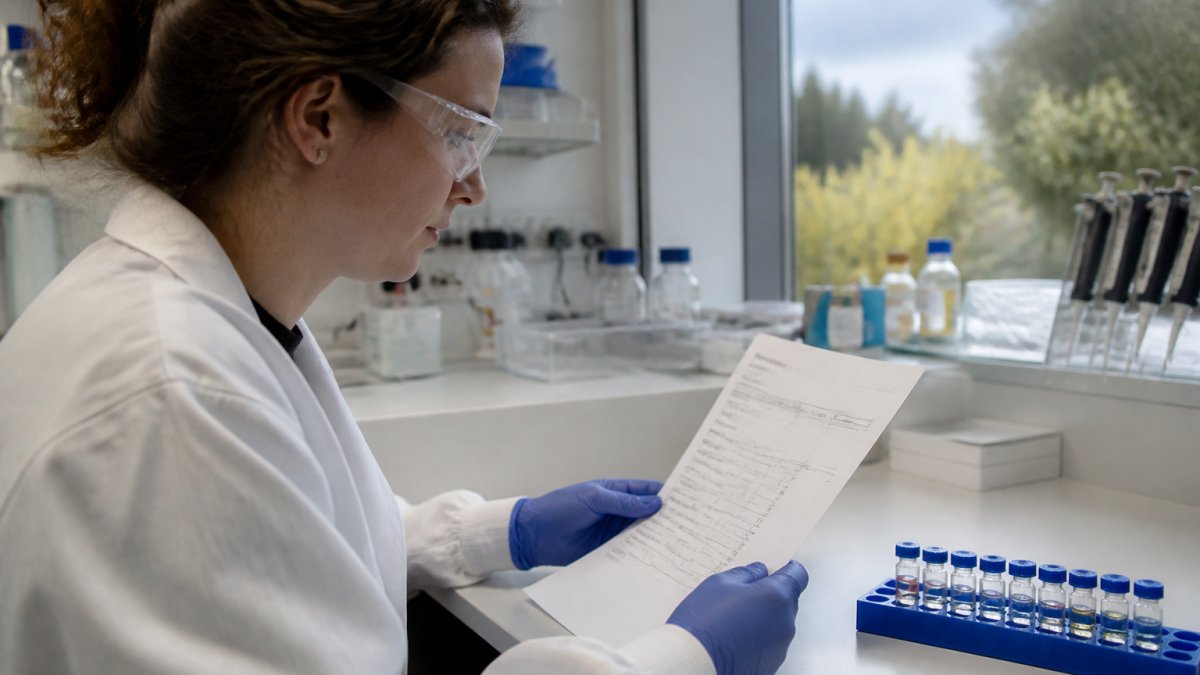
Check that the batch reference on the document matches the batch on your vial label.
What most guides miss is that a COA is a batch-specific record, not a product specification. Two vials of the same catalogue item from different batches should each carry their own document.
At JGPep+, every product ships with a batch-specific Certificate of Analysis so you can verify the record against the vial in front of you.
Common Mistakes When Selecting Purity Levels
The most frequent error is treating purity as a single universal target rather than a specification matched to the application. A close second is accepting a purity figure without checking how it was measured.
- Ordering one grade for everything. ELISA, Western blot and immunohistochemistry have genuinely different tolerances. Match the grade to the assay.
- Ignoring the analytical method. A purity figure with no stated HPLC method or wavelength cannot be compared with another supplier's figure.
- Skipping the mass confirmation. Purity without identity verification leaves the sequence itself unchecked.
- Assuming batch consistency. Ask for the batch-specific COA every time, and compare it against previous batches.
- Buying on price alone. The cheapest peptide is expensive if it costs you a repeat immunisation cycle.
Conclusion
Selecting purity levels without matching them to your downstream application is the quiet failure mode in antibody projects, and it usually surfaces only after the bleeds have been tested. Getting the specification right at the point of ordering costs far less than repeating an immunisation schedule. JGPep+ supplies research peptides for in vitro and analytical work with clear product identification, stated vial contents, accessible batch-specific COA documentation, and tracked UK dispatch with free delivery on qualifying orders. View the complete research peptide catalogue and compare specifications against the documentation before your next project begins.
Frequently Asked Questions
What peptide purity is recommended for antibody production?
For most antibody generation projects, 95% purity by HPLC is the practical minimum, and 98% or higher is preferred for sensitive applications such as competitive ELISA or when the epitope is short. If the peptide will be conjugated to a carrier protein, impurities above 5% can compete for conjugation sites and reduce the effective antigen dose. For routine polyclonal work, 90-95% is often sufficient; for monoclonal development, aim higher.
Does higher peptide purity always produce better antibodies?
No. Purity above roughly 98% gives diminishing returns for most polyclonal projects because other variables, such as epitope design, conjugation chemistry, and immunisation schedule, dominate the outcome. A 95% pure peptide with a well-chosen epitope will usually outperform a 99% pure peptide with a poor one. Purity removes a source of variability; it does not guarantee a strong immune response.
How can peptide impurities affect antibody production?
Impurities from incomplete coupling or deletion sequences can act as unintended antigens, so the resulting antiserum may contain antibodies against truncated or modified sequences rather than your target epitope. In conjugation reactions, free impurities compete for carrier protein binding sites, lowering the density of the correct antigen. This shows up later as high background, poor specificity, or lot-to-lot variability in assays.
How is peptide purity measured?
Purity is normally measured by reverse-phase HPLC, which separates the target peptide from deletion sequences and other by-products and reports the target peak as a percentage of total peak area. Mass spectrometry confirms the molecular weight matches the expected sequence. HPLC tells you how much of the material is your peptide; mass spectrometry tells you whether the main peak is the right molecule. A batch-specific Certificate of Analysis should report both.
What is the difference between crude and purified peptides?
Crude peptides are cleaved from the resin and used without chromatographic purification, typically at 60-80% purity. Purified peptides go through one or more HPLC steps to reach 90-98% or higher. Crude material is cheaper and faster to produce but contains more deletion sequences and residual reagents, which makes it unsuitable for antibody work where the immunogen needs to be well defined. Purified peptide is the standard choice for immunisation.
Should a peptide be purified before conjugation to a carrier protein?
Yes, in almost every case. Conjugation chemistry such as maleimide-cysteine or EDC coupling reacts with functional groups, and impurities carrying the same groups compete for the carrier. That lowers the epitope density on the final immunogen and introduces unwanted antigenic determinants. Purifying to at least 90-95% before conjugation gives a more predictable conjugate and a cleaner immune response.
What information should a peptide Certificate of Analysis include?
A useful Certificate of Analysis should state the batch or lot number, the peptide sequence, the purity figure with the HPLC method used, the mass spectrometry result against theoretical mass, the appearance and quantity, and the date of analysis. Without a batch number, the document cannot be tied to the vial you received. Ask for the specific batch COA rather than a generic specification sheet, and check that the sequence and mass match what you ordered.
How should I choose a peptide purity level for antibody production?
Start with the assay the antibody will be used in. For routine Western blot or immunohistochemistry with polyclonal sera, 90-95% purity is usually adequate. For competitive ELISA, monoclonal development, or short epitopes under 10 residues, choose 95-98% or higher. If the peptide is difficult to synthesise, a slightly lower purity with a full mass spectrometry confirmation may be more practical than chasing 98% at high cost.