 ultimate-guide
Batch Specific Certificate of Analysis: A 2026 Guide
Table of Contents
- What Makes a Certificate of Analysis Batch Specific?
- How to Read a Peptide COA: A Section-by-Section Breakdown
- Peptide Purity Testing Standards in UK Research
- Interpreting Peptide Chromatograms: Peaks, Baselines, and Impurities
- Common Mistakes When Reviewing Batch Specific COAs
- How Batch Documentation Supports Analytical Method Development
- Frequently Asked Questions
Last Updated: 25 September 2026
What Makes a Certificate of Analysis Batch Specific?
A batch specific certificate of analysis is a document that reports the actual measured results for one individual production lot, rather than a generic specification sheet. At JGPep+, every product ships with its own batch-specific COA, so the figures you read belong to the vial in your hand.
That distinction matters more than most researchers realise. A generic COA tells you what a supplier claims their process can achieve. A batch-specific document tells you what was measured on the material you actually received, by which method, and on what date.
Batch specificity is what makes a COA usable as evidence in a publication, a method validation file, or an internal quality record. Without a lot number tying the data to the vial, the document is marketing material, not analytical evidence.
Below, we break down how to read each section, what the figures should look like, and where reviewers most often go wrong.
How to Read a Peptide COA: A Section-by-Section Breakdown
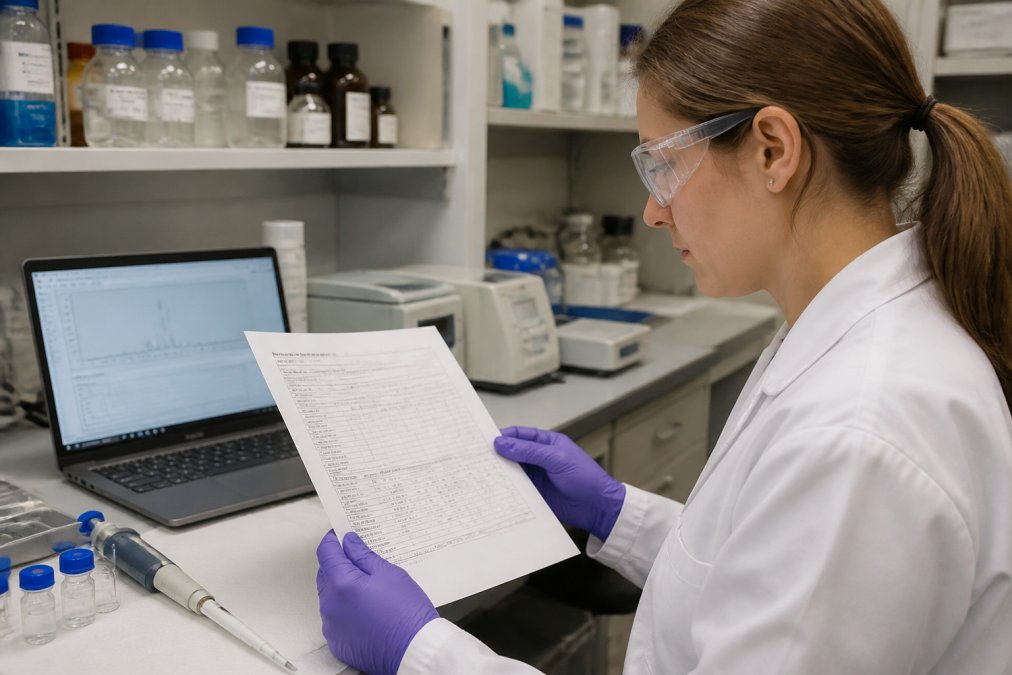
Reading a peptide COA means matching each reported figure to a stated method and a stated batch. A well-built document follows a predictable order: identity, purity, batch metadata, then supporting raw data.
Identity and Purity Data
Identity confirmation is the section that proves the material is the peptide named on the label, not a structural relative. It normally reports molecular mass against the theoretical value, and sometimes an amino acid analysis. Expect both a theoretical figure and an observed figure; the gap between them is what matters.
Purity is reported as a percentage derived from chromatographic peak area. A figure such as 98.2% means that proportion of the detected peak area belongs to the target peptide. It says nothing about what the remaining percentage consists of, which is why the chromatogram itself matters as much as the headline number.
The European Pharmacopoeia general chapters on chromatographic separation set out the method principles that most peptide purity testing follows, including how peak area is calculated and reported.
Batch Number, Storage, and Retest Information
Three fields turn a COA from a specification into a traceable record.
- Batch or lot number must match the label on the vial exactly, character for character.
- Manufacture and test dates establish how old the analytical data is.
- Storage conditions and retest date tell you how long the material is expected to remain within specification under those conditions.
A common mistake is treating the retest date as an expiry date. They are not the same thing. A retest date signals when the material should be re-analysed before continued use; it is not a claim about degradation.
If any of these three fields is missing, the document cannot be tied to your sample, and its value drops sharply.
Peptide Purity Testing Standards in UK Research
Purity testing standards in research settings rest on three techniques working together: high-performance liquid chromatography for purity, mass spectrometry for identity, and often Karl Fischer titration or similar for residual water content. No single technique confirms a peptide on its own.
The Medicines and Healthcare products Regulatory Agency guidance on laboratory standards is written for regulated manufacturing, but the analytical principles it describes, including method validation and documentation of results, are the same ones research laboratories apply when assessing supplier documentation.
What most guides miss is that a purity figure is only meaningful alongside the method that produced it. A 99% result from a poorly resolved gradient tells you less than a 96% result from a well-validated method with a clean baseline. When you compare documentation across suppliers, compare the methods, not just the percentages.
Interpreting Peptide Chromatograms: Peaks, Baselines, and Impurities
Interpreting a chromatogram comes down to three things: how clean the baseline is, how the main peak is shaped, and what else is visible on the trace. The percentage in the purity section is a summary of what the chromatogram shows in full.
View the complete research peptide catalogue →
A well-behaved trace has a flat baseline, a single dominant peak with symmetrical sides, and small, clearly separated impurity peaks. Watch for these patterns:
- Fronting or tailing on the main peak suggests column issues or overloaded injection, which can distort the calculated purity.
- A rising baseline under the main peak often means the integration was set generously, inflating the purity figure.
- Unresolved shoulders on the main peak indicate a closely eluting impurity that may not be counted separately.
- Late-eluting peaks can carry through between runs and appear in the next sample's trace.
The practical takeaway: read the chromatogram before you read the percentage. A purity figure derived from a poorly integrated trace is a number without a foundation.
Common Mistakes When Reviewing Batch Specific COAs
The most frequent error is accepting a batch specific certificate of analysis that has no batch number on it. Without that link, you cannot demonstrate which lot the data describes, and reviewers will flag it.
Other recurring problems:
- Comparing percentages across different methods. A purity figure from one laboratory's gradient is not directly comparable to another's.
- Ignoring the test date. Analytical data from several years ago may not reflect the material as it stands now.
- Treating a specification sheet as a COA. A specification states targets; a COA states measured results. They are different documents.
- Skipping the identity section. Purity without confirmed identity tells you the sample is clean, not that it is the right peptide.
- Filing the COA without the chromatogram. The trace is the evidence; the percentage is the summary.
| Mistake | What It Looks Like | Practical Fix |
|---|---|---|
| No batch number | Generic document, no lot reference | Request the batch-specific version before ordering |
| Mixed methods | Purity figures from different gradients | Compare method sections, not just percentages |
| Stale data | Test date years before purchase | Check test date against your project timeline |
| Spec sheet as COA | Targets stated, no measured results | Ask for measured values and raw data |
| Missing chromatogram | Percentage only, no trace | Request the full trace with integration details |
How Batch Documentation Supports Analytical Method Development
Method development depends on knowing exactly what you started with. A batch specific certificate of analysis gives you a fixed reference point: a known purity, a known identity, and a known test date, all tied to one lot.
When you validate a new analytical method, you need a standard whose composition you can state precisely. Batch documentation lets you write that statement with confidence, and it lets a collaborator reproduce your work using material from the same lot, or at least from a lot with comparable measured characteristics.
The Royal Society of Chemistry resources on analytical method validation cover the documentation principles that underpin this kind of traceability in research laboratories.
Batch-to-batch consistency is the other half of the picture.
Frequently Asked Questions
What is the difference between a generic COA and a batch-specific COA?
A generic COA is a template document that may apply to a product line rather than a specific production run. A batch specific certificate of analysis is tied to one manufacturing batch and includes that batch's unique number, test results, and release date. For research, a batch-specific COA is the only way to verify the actual material you receive, because it confirms identity, purity, and impurity profiles for that exact lot.
Why is a batch-specific certificate of analysis critical for peptide research?
Peptide research depends on reproducibility. A batch specific COA links your experiments to documented analytical data such as high-performance liquid chromatography (HPLC) purity and mass spectrometry identity. Without it, you cannot confirm that two shipments share the same composition, which can invalidate comparisons or method development. It also provides an audit trail for publications and internal quality records.
What information should be included in a batch-specific certificate of analysis?
A complete batch-specific COA should state the product name, catalogue reference, batch number, nominal amount, and storage conditions. It should include test results for identity (for example, mass spectrometry), purity (HPLC percentage), and any specified impurities. The document should also list the analytical methods used, the date of testing, and a retest or expiry date. This allows you to assess peptide purity testing standards and compare batches directly.
How do you verify the authenticity of a batch-specific COA?
Check that the batch number on the COA matches the batch number on the vial label. Look for consistent formatting, method details, and a traceable document reference. Reputable suppliers provide COAs that can be accessed directly from the product page or on request. If the document lacks a batch number or seems generic, treat it as unverified. JGPep+ provides batch-specific COAs for every product, so you can confirm the document matches your order.
Does JGPep+ provide batch-specific COAs for all research materials?
Yes. JGPep+ supplies a batch-specific certificate of analysis for every product in its catalogue. Each COA is linked to the exact batch dispatched, so you can verify identity, purity, and testing details before or after ordering. This supports laboratory managers and principal investigators who need documented materials for in vitro and analytical work.
How does a batch-specific COA support analytical method development?
Method development requires known reference materials. A batch-specific COA provides the purity, identity, and impurity profile of your starting material, which helps you set system suitability parameters and interpret results. When you are interpreting peptide chromatograms, knowing the expected retention time and peak purity from the COA allows you to distinguish sample peaks from artefacts. It also helps you document method validation using a traceable batch record.