 listicle
Peptide COA: 10 Essential Components Explained
Table of Contents
- Why the Peptide COA Matters More Than the Label
- 1. Batch Number and Product Identification
- 2. Analytical Methods and HPLC Purity Percentage
- 3. Mass Spectrometry Verification for Identity
- 4. Net Peptide Content vs Gross Weight
- 5. Counterion and Water Content
- 6. Endotoxin and Bioburden Testing
- 7. Storage Conditions and Retest Date
- Summary Table of the 10 Essential Components
- Making COA Review Part of Your Protocol
- Frequently Asked Questions
Last Updated: September 7, 2026
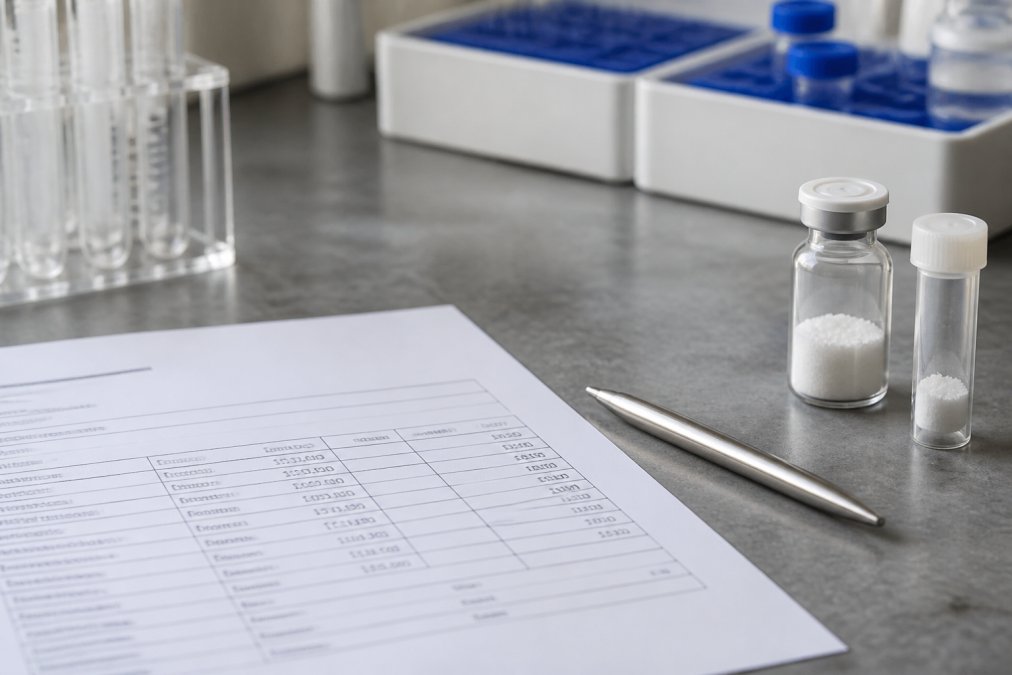
A Certificate of Analysis (COA) is the single most important document accompanying a research peptide, yet many researchers skim past it. A peptide COA is the batch-specific record that verifies what is actually inside the vial, how it was tested, and whether it meets the supplier's stated specifications. At JGPep+, we provide a batch-specific Certificate of Analysis for every product precisely because documentation is where responsible research supply stands or falls. Below, we break down the 10 essential components of a peptide COA so you can verify quality claims with confidence rather than taking a label at face value.
Why the Peptide COA Matters More Than the Label
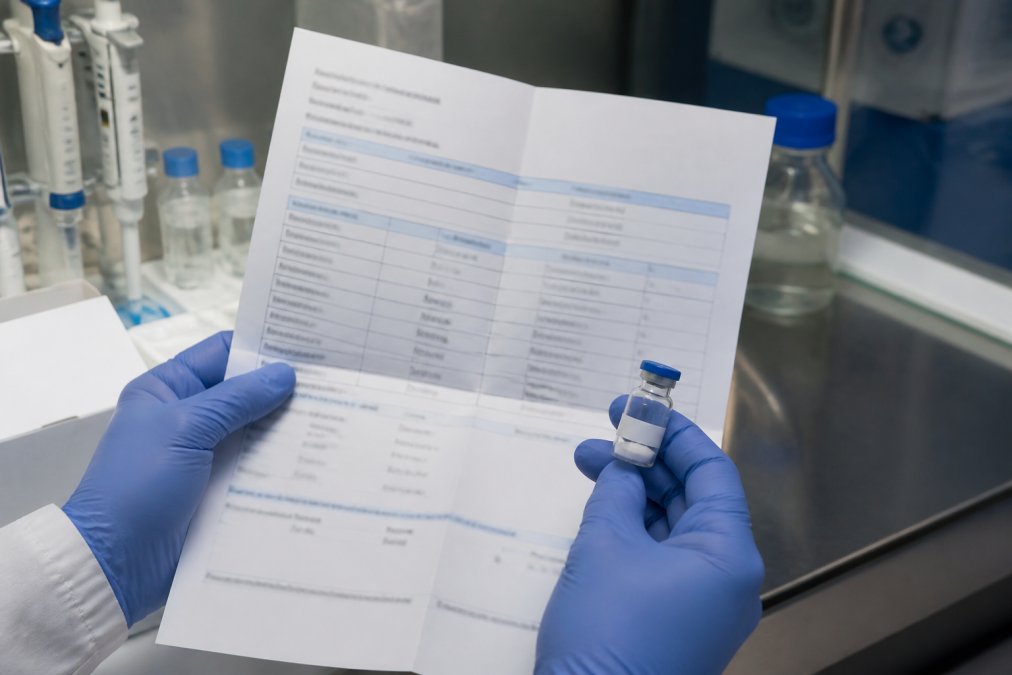
The label on a vial tells you what the supplier wants you to believe. The peptide COA tells you what the laboratory actually measured. These are not always the same thing, and the gap between them is where quality problems hide.
A meaningful COA is batch-specific, meaning it documents the exact lot you received, not a generic template reused for every order. This matters because synthesis and purification can vary between production runs. A batch-specific document lets you trace any anomaly back to its source and gives you a baseline for comparing future orders from the same supplier.
Without proper documentation, you cannot verify purity claims, confirm peptide identity, or assess whether the material is suitable for your analytical method. For in vitro and non-clinical research, where experimental reproducibility depends on consistent inputs, the COA is your primary safeguard.
1. Batch Number and Product Identification
The first essential component is clear product identification. This includes the peptide name, sequence, catalogue reference, and the specific batch or lot number. These details anchor the entire document to a single, traceable production run.
The batch number is not administrative paperwork. It is the key that links the COA to the physical vial in your hand. If you ever need to report a quality issue, compare results across experiments, or verify a product's history, the batch number is how you do it.
A common mistake is assuming that a product name alone is sufficient identification. Different suppliers may use different naming conventions, and some sequences are sold under multiple names. A proper COA removes ambiguity by stating the exact sequence and linking it to a specific catalogue reference and batch number.
2. Analytical Methods and HPLC Purity Percentage
High-performance liquid chromatography (HPLC) is the standard method for determining peptide purity. The COA should state the analytical method used and report the purity as a percentage, typically above 95% for research-grade material.
The purity percentage reflects the proportion of the target peptide relative to other components in the sample. However, the number alone is not enough. A reliable COA also specifies the HPLC method conditions, including the column type, mobile phase, and detection wavelength, so you can assess whether the analysis was appropriate.
Many suppliers advertise "99% purity" as a marketing claim. The peptide COA is where that claim is either substantiated or exposed. Check that the purity percentage matches the method described and that the document refers to your specific batch, not a historical average.
3. Mass Spectrometry Verification for Identity
HPLC tells you how pure the sample is, but it does not confirm that the molecule present is the correct one. That is the role of mass spectrometry. A proper peptide COA includes mass spectrometry data verifying the molecular mass of the peptide against its theoretical value.
The mass spectrometry result confirms that the synthesis produced the correct sequence and that the peptide has not degraded or formed unexpected by-products. This is particularly important for longer peptides, where synthesis errors are more common. When reviewing a COA, cross-check the reported molecular mass against the theoretical mass for your peptide sequence.
For an overview of how mass spectrometry principles apply to biomolecule verification, the Royal Society of Chemistry's analytical guidance provides useful technical background.
4. Net Peptide Content vs Gross Weight
One of the most misunderstood components of a peptide COA is the distinction between net peptide content and gross weight. Gross weight is the total mass of material in the vial, including water, salts, and counterions. Net peptide content is the actual mass of the peptide itself.
This distinction matters because peptides are typically supplied as a salt, such as acetate or trifluoroacetate, and they absorb water from the atmosphere. A vial labelled "5 mg" may contain significantly less than 5 mg of actual peptide once these factors are accounted for.
A transparent COA states both values. When comparing net peptide content vs gross weight across suppliers, you need the net figure to calculate accurate molar concentrations for your experiments. A supplier that only reports gross weight is either being careless or hoping you will not notice the discrepancy.
5. Counterion and Water Content
Building on the previous point, the counterion and water content directly affect how much peptide you are actually working with. Most synthetic peptides are purified as salt forms, with the counterion contributing to the total mass.
The COA should identify the counterion species, such as acetate or trifluoroacetate, and report the percentage present. Water content, typically measured by Karl Fischer titration, is equally important. Peptides are hygroscopic, and residual water can account for a meaningful fraction of the gross weight.
These figures are essential for accurate reconstitution. If you dissolve a peptide based on gross weight without accounting for counterion and water content, your actual concentration will be lower than intended. This is a common source of inconsistent experimental results that is entirely avoidable with proper COA review.
6. Endotoxin and Bioburden Testing
For in vitro research, endotoxin and bioburden testing may seem less critical than for clinical applications, but they still matter. Endotoxins are lipopolysaccharides from bacterial cell walls that can interfere with cell-based assays even at low concentrations.
A thorough peptide COA reports endotoxin levels, typically in endotoxin units per milligram, and may include bioburden testing for microbial contamination. The acceptable limits depend on your application. Cell culture work is more sensitive to endotoxin contamination than simple analytical chemistry.
The Medicines and Healthcare products Regulatory Agency guidance on endotoxin testing outlines the regulatory expectations for endotoxin limits that inform good manufacturing practice, which provides a useful reference point for understanding what the figures mean.
7. Storage Conditions and Retest Date
The final essential component is practical guidance on storage. A peptide COA should state the recommended storage conditions, such as temperature range and protection from light and moisture, along with a retest date or expiry date.
Storage conditions directly affect peptide stability. Most lyophilised peptides are stable when stored frozen and desiccated, but once reconstituted, they degrade rapidly. The COA's storage guidance tells you how to preserve the material's integrity from receipt through to use.
The retest date indicates how long the supplier guarantees the product will meet specifications under proper storage. Using a peptide beyond this date means you are working with material whose quality you cannot verify. For long-term research projects, check the retest date at receipt and plan your usage accordingly.
Summary Table of the 10 Essential Components
| Component | What It Tells You | Why It Matters |
|---|---|---|
| Batch number and product ID | Exact lot and sequence | Traceability and verification |
| HPLC purity percentage | Level of impurities | Confirms quality claims |
| Mass spectrometry data | Correct molecular identity | Prevents wrong-sequence errors |
| Net peptide content | Actual peptide mass | Accurate concentration calculations |
| Counterion and water content | Non-peptide mass components | Correct reconstitution volumes |
| Endotoxin testing | Bacterial contamination level | Protects cell-based assays |
| Storage conditions and retest date | Stability requirements | Maintains material integrity |
Making COA Review Part of Your Protocol
Reviewing a peptide COA should be a standard step before any new batch enters your workflow, not an afterthought. A few minutes spent verifying the components above can prevent weeks of wasted experiments caused by incorrect concentration, wrong identity, or unexpected contamination.
When evaluating a supplier, ask whether the COA is batch-specific and available before you order. Generic documentation that could apply to any batch is a red flag. The guidance on analytical method validation from the British Pharmacopoeia reinforces why method transparency and documented testing are central to trustworthy quality control.
For researchers who need to compare specifications across suppliers, clear documentation is the difference between a straightforward appraisal and a guessing game. Suppliers that provide batch-specific COAs with the components described above make it possible to assess quality objectively.
Frequently Asked Questions
What is a Certificate of Analysis for peptides?
A Certificate of Analysis (COA) is a document from the supplier that reports the results of quality control tests performed on a specific batch of peptide. It verifies the product's identity, purity, and content. A proper peptide COA is batch-specific, meaning it lists the exact batch number tested and shows data for that batch only, not generic results for the product line.
Why is a batch-specific COA important for laboratory research?
A batch-specific COA is crucial for experimental consistency and reproducibility. Peptide synthesis can vary between batches, so a COA tied to your exact batch number confirms the purity and content of the material you actually received. This documentation allows you to compare specifications across suppliers and ensures your experimental results can be traced back to verified starting materials.
How do you verify the purity of a peptide from a COA?
Purity is typically verified using HPLC (High-Performance Liquid Chromatography) analysis. Look for the chromatogram and the calculated purity percentage for most research applications. The COA should state the method used and show the analysis date. Cross-check this value against the mass spectrometry result, which confirms the molecular identity, to ensure the purity claim is trustworthy.
What does 'net peptide content' mean on a COA?
Net peptide content refers to the actual weight of the peptide itself, excluding counterions, water, and residual solvents. This is different from gross weight, which is the total vial fill. The difference matters because a peptide salt (like acetate or TFA) adds mass. A COA that states net peptide content allows you to calculate the correct amount for your solution, ensuring accurate concentrations for your experiments.
How can researchers identify a fraudulent peptide COA?
A fraudulent COA often lacks batch-specific data, uses a generic template, or omits critical tests like mass spectrometry. Check that the batch number on the COA matches your vial. Verify the document includes raw data such as an HPLC chromatogram and MS spectra, not just a summary table. If the supplier cannot provide a COA before purchase or the document looks overly simplified, treat it as a red flag.
The challenge is that not all COAs are created equal. Some are thorough, batch-specific documents; others are marketing collateral dressed up as quality assurance. The difference shows up in your results. At JGPep+, we provide clear product identification, stated vial contents, and a batch-specific Certificate of Analysis for every product, backed by transparent GBP pricing and tracked UK dispatch. View the complete research peptide catalogue and verify our documentation for yourself.