 blog
blog
Bluepeak vs UKPeptides for Research Materials
Table of Contents
- Bluepeak vs UKPeptides: What Actually Matters for Research Materials
- How to Verify Peptide Purity Before You Commit to a Supplier
- Batch-Specific Certificate of Analysis: Reading the Document That Decides Your Experiment
- Research Peptide Vial Contents: What Should Be Listed and Why It Matters
- Shipping, Dispatch and Documentation: Where Supplier Choice Affects Your Timeline
- Research Materials Supplier Checklist: What to Confirm Before Ordering
- Frequently Asked Questions
Last Updated: 5 October 2026
Bluepeak vs UKPeptides: What Actually Matters for Research Materials
Choosing between Bluepeak and UKPeptides for research materials usually comes down to one question: which supplier gives you documentation you can actually verify? This guide from JGPep+ breaks down the comparison criteria that matter most, from batch-specific Certificates of Analysis to dispatch reliability.
Here is the honest starting point. Vague purity claims are easy to print and hard to check. A batch-specific Certificate of Analysis is not. That single document, tied to the exact lot number on your vial, separates suppliers you can build a method around from suppliers you have to take on faith.
Below, we walk through how to verify peptide purity, what a COA should contain, what belongs on a vial label, and how shipping and documentation affect your timeline. The same checklist applies whether you are comparing Bluepeak, UKPeptides, or any other supplier.
How to Verify Peptide Purity Before You Commit to a Supplier
Verifying peptide purity starts with one principle: never accept a purity figure that is not tied to a specific batch number. A generic "99% pure" claim on a product page tells you nothing about the vial in your hand.
A common approach among analytical labs is to request the COA for the exact lot before ordering. Check three things:
- The lot or batch number matches the vial you receive
- The analytical method is named (typically HPLC)
- The purity figure and the chromatogram data agree
If a supplier cannot produce a batch-linked document on request, treat that as your answer. Many labs also run an in-house confirmation, such as a quick HPLC check or mass confirmation, on first orders from any new supplier.
Batch-Specific Certificate of Analysis: Reading the Document That Decides Your Experiment
A batch-specific Certificate of Analysis is the document that records the measured results for one production lot of a peptide. It should state the lot number, the analytical methods used, the purity result, and the identity confirmation.
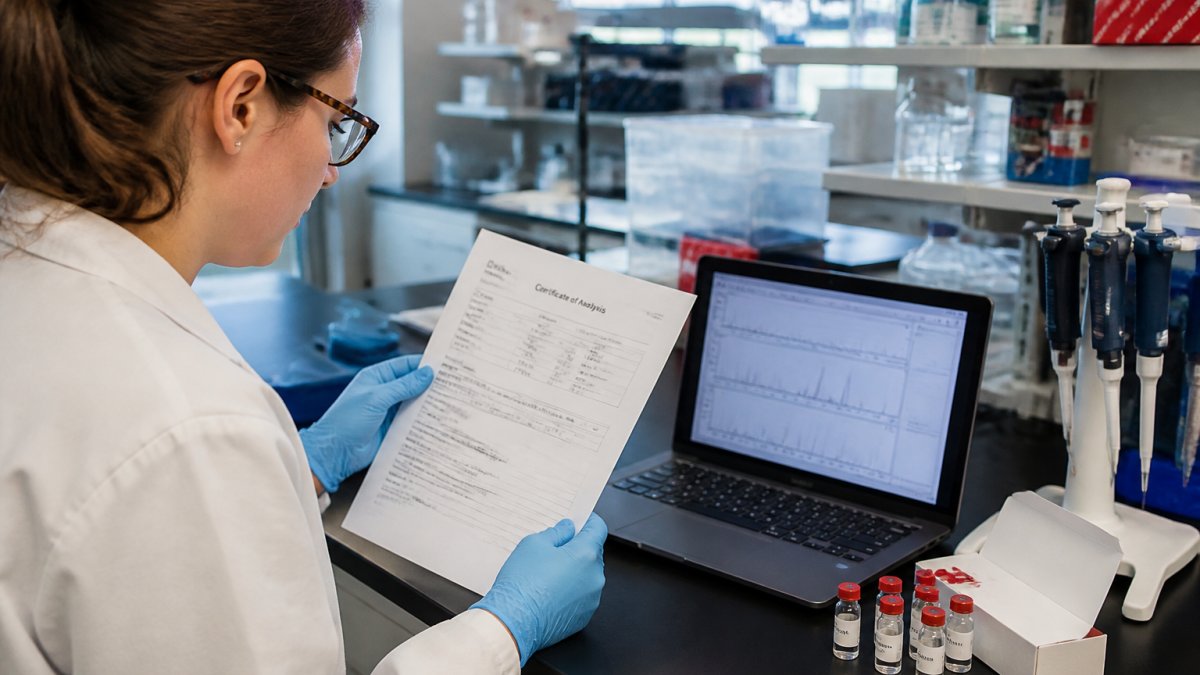
Read it in this order. First, confirm the lot number matches your vial. Second, check the purity figure and the method behind it. Third, look for identity confirmation, such as mass spectrometry data matching the expected molecular mass. Fourth, note the storage guidance and any handling notes.
What most guides miss is that a COA is only useful if it is retrievable later. If you need to reference a batch months after purchase, for a publication or an audit trail, the document needs to be accessible, not buried in an email thread. At JGPep+, we make batch-specific COA documentation accessible for every product so records can be checked when it matters.
Research Peptide Vial Contents: What Should Be Listed and Why It Matters
Research peptide vial contents should be listed clearly enough that you can appraise the material without guessing. At minimum, a label should state the peptide name, the stated strength or nominal amount, the batch number, and the form supplied.
Vague product names create real problems for analytical work. If you cannot tell the strength or the nominal amount from the listing, you cannot plan a dilution series or compare specifications across suppliers. That is a procurement risk, not a minor inconvenience.
When comparing suppliers, note whether the catalogue gives you:
View the complete research peptide catalogue →
- Clear product identification and stated strengths
- Specific catalogue references for each item
- The nominal amount per vial
A supplier that publishes this information lets you do a proper specification appraisal before you commit budget. One that does not leaves you ordering blind.
Shipping, Dispatch and Documentation: Where Supplier Choice Affects Your Timeline
Dispatch reliability is where supplier choice quietly makes or breaks a deadline. A domestic supplier with tracked dispatch removes the customs delays that derail publication timelines.
If your last orders from overseas suppliers sat in customs for a week, you already know the cost. A missed deadline is rarely about the science; it is about logistics. Tracked domestic dispatch gives you a verifiable chain from order to bench.
Documentation travels with the shipment. Confirm that the COA is issued for the same batch that is dispatched, and that you receive it alongside the order rather than on request weeks later. JGPep+ provides tracked UK dispatch and free delivery on qualifying orders, with batch-specific documentation for every product.
Research Materials Supplier Checklist: What to Confirm Before Ordering
Use this checklist before committing to any supplier. It applies equally to Bluepeak, UKPeptides, and any other source of research materials.
| What to Confirm | Why It Matters | Red Flag If Missing |
|---|---|---|
| Batch-specific COA available pre-order | Confirms purity for your exact lot | Only a generic certificate offered |
| Lot number on vial matches COA | Preserves traceability | Numbers do not match |
| Analytical method named | Lets you judge the purity figure | Purity stated with no method |
| Stated strength and nominal amount | Enables specification comparison | Vague product names only |
| Tracked domestic dispatch | Protects your timeline | No tracking provided |
| Documentation ships with order | Keeps your records complete | COA only on request |
| Clear returns or replacement process | Covers a documentation mismatch | No stated process |
Work through it in order. The first three items decide whether the material is fit for purpose; the last four decide whether the supplier is reliable to work with over a project.
Comparing suppliers is really about comparing documentation, and that is where the decision gets easier. JGPep+ supplies peptides and laboratory materials exclusively for in vitro, analytical and non-clinical research, with clear product identification, stated vial contents, and a batch-specific Certificate of Analysis for every product. Our tracked UK dispatch and free delivery on orders over £100 keep your timeline intact, and our transparent GBP pricing lets you plan a budget without guesswork. View the complete research peptide catalogue and check the batch records for yourself.
Frequently Asked Questions
How should researchers compare peptide suppliers?
Start with documentation. A supplier should provide a batch-specific Certificate of Analysis for every lot, listing the batch number, test method, and measured purity. Check that vial contents state the nominal amount and stated strength clearly. Confirm dispatch location and delivery terms, since overseas shipping can add customs delays. Finally, check whether the supplier publishes transparent pricing in GBP and offers a returns process if documentation does not match the delivered batch. A research materials supplier checklist covering these points gives you a consistent basis for comparison.
What should a batch-specific Certificate of Analysis include?
A batch-specific COA should identify the exact lot number, the testing method used (typically HPLC for purity and mass spectrometry for identity), the measured purity percentage, and the date of testing. It should match the batch number printed on the vial you receive. Generic certificates that apply to a product line rather than a specific batch do not let you verify what is actually in your vial. If a supplier cannot provide a batch-matched COA on request, that is a clear signal to look elsewhere.
How can you verify a research peptide's identity and purity?
The COA is your starting point: check that the batch number matches your vial and that purity was measured by HPLC. For independent verification, many laboratories run their own in-house analysis, such as HPLC or mass spectrometry, against the supplier's stated figures. Comparing your results with the COA confirms whether the batch performs as documented. If purity in your analysis differs significantly from the certificate, contact the supplier with your data and ask for an explanation or replacement.
What information should a peptide supplier provide about vial contents?
Each vial should state the peptide name, the nominal amount (for example, 5 mg or 10 mg), the stated strength or concentration, the batch number, and storage recommendations. Without these details, you cannot calculate accurate dilutions or compare batches across orders. Suppliers who list only a vague product name make it difficult to appraise specifications for analytical work. Clear vial labelling also supports traceability if you need to reference a specific batch in your research records.