 ultimate-guide
Is Buying Research Peptides Online Safe? UK Guide
Table of Contents
- What Makes Buying Research Peptides Online Risky
- How to Verify Peptide Purity Before You Order
- The Importance of COA for Peptides: What to Look For
- Legal Status of Research Chemicals UK: What Buyers Should Know
- Red Flags That Signal an Unsafe Research Peptide Supplier
- How to Store and Handle Research Peptides Safely in the Lab
- Frequently Asked Questions
Last Updated: September 26, 2026
What Makes Buying Research Peptides Online Risky
Buying research peptides online is risky because the buyer cannot see the vial, the synthesis record or the testing data before payment, and the market contains suppliers who trade on unverifiable purity claims. This guide from JGPep+ explains how to judge a supplier on evidence rather than marketing. The core problem is simple: a peptide is a white powder in a glass vial, and two vials that look identical can differ enormously in identity, purity and salt form.
Most buyers assume a purity figure printed on a label means something. It usually means nothing unless it is tied to a specific batch and a specific test method.
The risks fall into four categories:
- Identity risk: the vial contains a different peptide, or a truncated sequence, from the one advertised
- Purity risk: synthesis by-products, residual solvents or water content push the real purity well below the claimed figure
- Documentation risk: the supplier supplies a generic certificate that belongs to no batch in particular
- Handling risk: the material degrades in transit or storage because it was never kept cold or desiccated
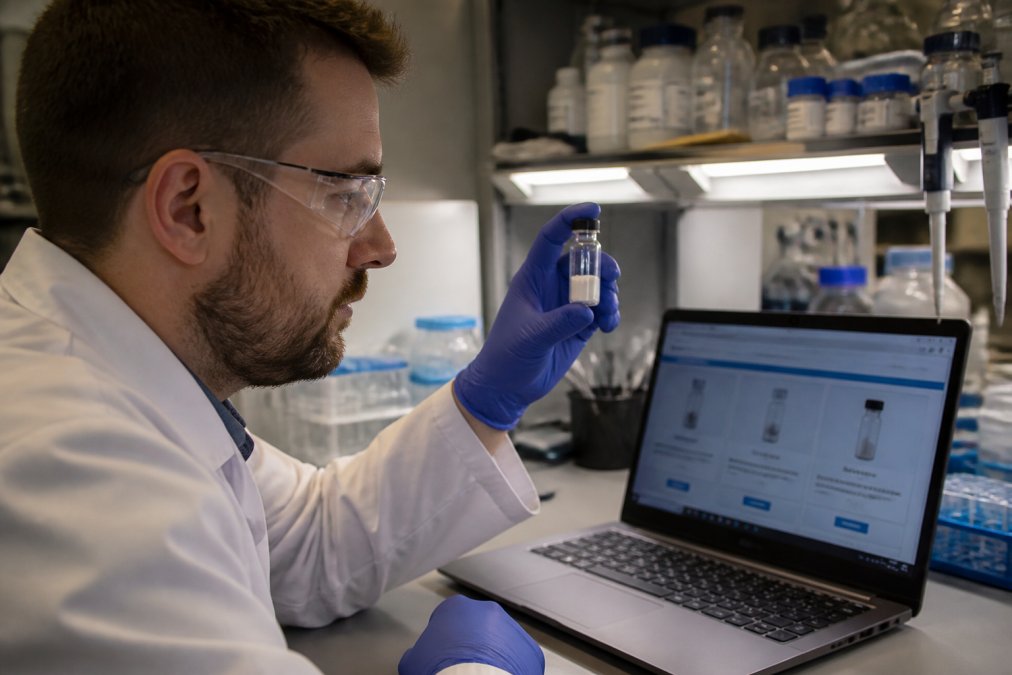
For laboratory work, the consequence of any one of these is wasted time and invalid data. A failed experiment rarely announces itself as a materials problem; it looks like a method problem, and teams can spend weeks chasing the wrong variable.
How to Verify Peptide Purity Before You Order
Verification starts before payment, not after delivery. A supplier who cannot show batch-specific analytical data on request is a supplier you cannot assess. Purity verification means matching three things: the analytical method used, the batch number on the vial, and the certificate that claims to describe that batch.
Reading HPLC and Mass Spectrometry Data
High-performance liquid chromatography (HPLC) separates the components of a sample and reports the relative area of each peak, which is how a purity percentage is derived. Mass spectrometry (MS) confirms molecular identity by measuring the mass-to-charge ratio against the theoretical mass of the expected peptide.
Read the two together. HPLC tells you how much of the material is the target peptide; MS tells you whether the target peptide is what you think it is. A purity figure without a mass confirmation is half a dataset.
What most guides miss is that HPLC conditions matter as much as the result. A chromatogram run on a shallow gradient with a slow flow rate will resolve closely eluting impurities that a fast generic method merges into the main peak. When you request data, ask for the column, gradient, wavelength and flow rate. A supplier who cannot state them is not running a method designed to find problems.
Batch Numbers and Reproducibility Checks
A batch number is the link between the vial in your hand and the data in the report. Without it, the certificate describes nothing.
Check that the batch number on the vial label matches the certificate exactly, including any suffix. Then check the test date: a certificate dated after your order was dispatched is a warning sign, not a reassurance. Finally, if you order the same catalogue item twice, compare the two certificates. Batch-to-batch variability is normal in synthesis, but a purity swing of several percentage points between consecutive batches tells you the quality control is reactive rather than controlled.
The Importance of COA for Peptides: What to Look For
A Certificate of Analysis is a batch-specific document that records what was tested, how it was tested and what the result was. Its value lies entirely in its specificity. A generic certificate covering a product line rather than a batch is not a COA in any useful sense.
| COA Element | What Good Looks Like | Red Flag |
|---|---|---|
| Batch identifier | Matches the vial label exactly | No batch number, or a generic lot code |
| Purity method | Named HPLC method with conditions | "Purity: 99%" with no method stated |
| Identity confirmation | MS data with observed and theoretical mass | Identity asserted, never measured |
| Appearance | Stated physical form and colour | Field left blank |
| Test date | Dated before dispatch | Undated, or dated after your order |
| Storage guidance | Specific temperature and light conditions | Vague or absent |
The importance of COA for peptides is not ceremonial. It is the only document that lets you reproduce someone else's result, defend your own data in review, or trace a problem back to a source.
Legal Status of Research Chemicals UK: What Buyers Should Know
The legal status of research chemicals in the UK depends on the substance, its intended use and the licence held by the buyer. Many peptides are controlled as prescription-only medicines when intended for human use, which is why reputable suppliers restrict sales to laboratory research and state clearly that products are not medicines.
View the complete research peptide catalogue →
This is the part buyers most often get wrong. The legality of a purchase is not determined by the supplier alone; it is determined by what you intend to do with the material. A peptide sold lawfully as a research reagent becomes a different legal question the moment it is intended for human consumption.
For laboratory buyers, the practical position is straightforward:
- Purchase only from suppliers who state the research-only restriction explicitly
- Keep purchase records and certificates alongside your project documentation
- Confirm your institution's own procurement policy before ordering
- Check the current classification of any specific compound before you commit to a project
UK legislation on psychoactive substances sets out the framework that governs many novel compounds, and MHRA guidance on medicines regulation explains when a substance is treated as a medicine. Classification changes, so verify the current position for your specific compound rather than relying on an older catalogue description.
Red Flags That Signal an Unsafe Research Peptide Supplier
Unsafe suppliers give themselves away through documentation gaps long before anything arrives. The pattern is consistent: strong claims, weak evidence.
Watch for these signals:
- Purity claims without data. "99% pure" with no chromatogram and no method is a marketing line.
- Certificates that cover a product, not a batch. If the document would apply to every order, it applies to none.
- No physical address or company details. A supplier who will not say who they are cannot be held to anything.
- Prices far below the market. Synthesis and testing cost money. A price that ignores both usually means one of them was skipped.
- Pressure to buy quickly. Genuine suppliers answer technical questions. They do not discourage them.
- No stated storage conditions. A supplier who does not tell you how to store the material does not expect you to test it properly.
- Vague product names. "Peptide X, 10mg" with no catalogue reference, sequence or stated strength makes comparison impossible.
The last point matters more than it appears. If you cannot compare specifications across suppliers, you cannot make an informed choice, and that is often the intention.
How to Store and Handle Research Peptides Safely in the Lab
Lyophilised peptides are stable when kept cold, dry and dark, and they degrade when any of those conditions fail.
A workable routine looks like this:
- Store lyophilised powder at -20°C for routine work, or lower for long-term archival storage
- Keep vials sealed and desiccated; moisture uptake is the most common cause of premature degradation
- Protect from light, particularly for peptides containing aromatic residues
- Allow vials to reach room temperature before opening, to prevent condensation on the powder
- Aliquot reconstituted material rather than freeze-thawing a single stock repeatedly
- Record reconstitution date, solvent and concentration in your lab notebook
At JGPep+, every product carries clear identification, stated vial contents and a batch-specific Certificate of Analysis, so the material you receive can be matched to the data that describes it before you open the vial.
Frequently Asked Questions
Are research peptides legal to purchase in the UK?
Research peptides are legal to buy in the UK when sold strictly for in vitro, analytical or educational laboratory use and not for human or veterinary consumption. The sale must comply with General Product Safety Regulations and, where relevant, the Psychoactive Substances Act 2016. Suppliers should clearly label products as not for human use. Buyers at UK institutions should check their own institutional procurement policies before ordering research peptides online.
What is a Certificate of Analysis (COA) and why is it essential?
A COA is a batch-specific document that reports the identity, purity and testing method for a peptide. It should include the batch number, HPLC trace, mass spectrometry data and the date of analysis. A COA is essential because it lets you verify that what you receive matches what was ordered. Without a batch-specific COA, you cannot confirm purity or detect variability between batches, which can undermine analytical and in vitro research results.
How can you verify the legitimacy of a peptide supplier?
Check whether the supplier provides batch-specific COAs before purchase, uses clear product identification and stated vial contents, and offers tracked UK dispatch. Look for transparent GBP pricing. Avoid suppliers that only show generic COAs or refuse to share batch documentation. You can also search the supplier name on Trustpilot. JGPep+ provides batch-specific COAs for every product.
What are the risks of buying peptides from unregulated online sources?
Unregulated sources may supply peptides with lower purity than stated, incorrect identity or inconsistent batch-to-batch quality. This can lead to failed experiments, wasted research time and unreliable analytical data. There is also a risk that products are not stored or shipped correctly, which can degrade the peptide. Without a batch-specific COA, you have no way to verify what you received, and customs delays from overseas suppliers can disrupt research timelines.