 how-to
5 Ways to Prevent Peptide Oxidation During Storage
Last Updated: 25 October 2026
Quick Summary
To prevent peptide oxidation during storage, maintain temperatures of -20°C or colder, store peptides in sealed vials under inert atmosphere (nitrogen or argon), and keep them in dry form away from light and moisture. These conditions minimise the three requirements for oxidation: your peptide, oxygen, and time.
- Store peptides at -20°C minimum; -80°C is superior for longer stability and -196°C liquid nitrogen offers best long-term protection
- Use sealed vials under inert atmosphere (nitrogen or argon) to exclude oxygen exposure
- Aliquot stock into smaller portions to minimise freeze-thaw cycles and air exposure during handling
- Store lyophilised powder in low humidity conditions rather than dissolved solutions
- Verify stability by re-analysing peptides at planned intervals using batch-specific Certificates of Analysis as baseline
Table of Contents
- What Causes Peptide Oxidation and Why Storage Matters
- Optimal Peptide Storage Conditions for Oxidation Prevention
- Understanding Methionine Oxidation in Peptides
- Peptide Aliquoting and Freeze-Thaw Cycles: Minimising Degradation
- Peptide Reconstitution and Storage After Opening
- Monitoring and Verifying Peptide Stability
- Setting Up Your Peptide Storage Protocol with Certified Materials
- Frequently Asked Questions
What Causes Peptide Oxidation and Why Storage Matters
Peptide oxidation is the chemical process where peptide molecules lose electrons when exposed to oxygen, leading to structural damage and loss of biological activity. This happens most commonly at methionine and tryptophan residues within the peptide chain. Understanding how to prevent peptide oxidation during storage is essential for maintaining the integrity of your research materials and ensuring reliable experimental results.
Oxidation doesn't just reduce purity, it fundamentally changes how your peptide behaves in experiments. A partially oxidised peptide may show different binding kinetics, altered solubility, or compromised activity compared to its native form. For analytical work and method development, this variability introduces noise into your data. For educational applications, degraded peptides teach the wrong lessons about peptide behaviour.
The good news: oxidation is largely preventable with the right storage approach. The process requires three conditions to occur: your peptide, oxygen, and time. Remove or minimise any one of these, and you slow degradation dramatically.
Optimal Peptide Storage Conditions for Oxidation Prevention
The most effective way to prevent peptide oxidation is controlling your storage environment. Temperature, atmosphere, and container choice work together to keep your peptides stable.
Temperature is your first lever. Store peptides at -20°C or colder whenever possible. Cold slows molecular movement and dramatically reduces oxidation rates. Room temperature storage is acceptable only for short-term use (days, not weeks). If you need longer stability, -80°C is superior to -20°C. Liquid nitrogen storage (-196°C) offers the best long-term protection but requires specialised equipment.
Oxygen exclusion is equally critical. Peptides stored in sealed vials under inert atmosphere (nitrogen or argon) oxidise far more slowly than those exposed to air. If your peptide arrives in a sealed vial, keep it sealed until you're ready to use it. Once opened, minimise air exposure during handling.
Moisture matters too. Peptides stored in dry form (lyophilised powder) are more stable than dissolved solutions. If your peptide is supplied as a powder, store it in a desiccator or with desiccant packets. Humidity accelerates oxidation, particularly at warmer temperatures.
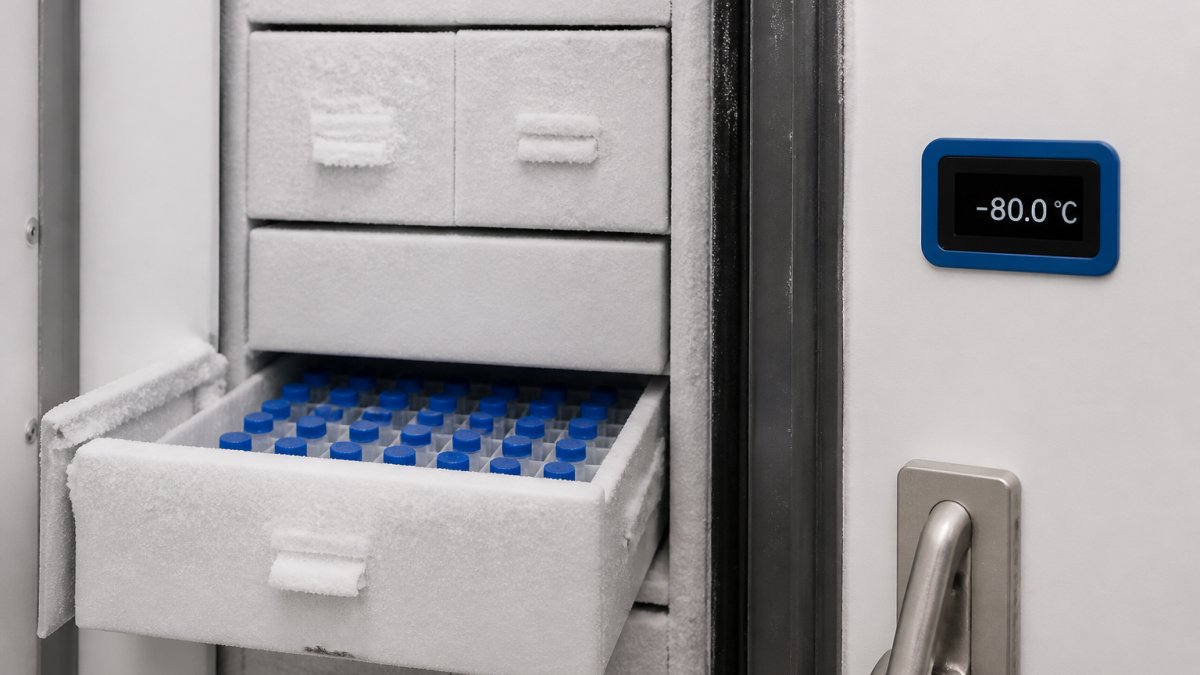
When setting up your storage protocol, prioritise in this order:
- Maintain -20°C minimum (non-negotiable)
- Use sealed, inert-atmosphere containers
- Store in a dark location (light accelerates oxidation)
- Keep away from heat sources and direct sunlight
- Maintain low humidity in storage area
For research materials from JGPep+, each product arrives with clear guidance on optimal storage conditions. The batch-specific Certificate of Analysis documents the initial peptide state, giving you a baseline to compare against after storage.
Effective peptide storage requires controlling temperature, atmosphere, and container choice to prevent oxidation.
| Factor | Condition | Notes |
|---|---|---|
| Temperature | -20°C minimum | Cold slows oxidation rates dramatically |
| Temperature | -80°C | Superior to -20°C for longer stability |
| Temperature | -196°C (liquid nitrogen) | Best long-term protection; requires specialised equipment |
| Atmosphere | Sealed inert (nitrogen or argon) | Oxidises far more slowly than air exposure |
| Storage form | Lyophilised powder | More stable than dissolved solutions |
| Light | Dark location | Light accelerates oxidation |
| Humidity | Low humidity | Moisture accelerates oxidation, especially at warmer temperatures |
Understanding Methionine Oxidation in Peptides
Methionine residues are oxidation hotspots. The sulphur atom in methionine's side chain readily accepts electrons from oxygen, forming methionine sulphoxide. This chemical change alters the peptide's three-dimensional structure and can impair binding or activity.
The challenge with methionine oxidation is that it's often reversible in theory but irreversible in practice. A methionine sulphoxide can be chemically reduced back to methionine under specific laboratory conditions, but this rarely happens during storage. Once oxidised, your methionine residues stay oxidised.
Peptides rich in methionine are inherently more vulnerable. If your research peptide contains multiple methionine residues, oxidation prevention becomes even more critical. This is why storage conditions matter so much, you cannot undo the damage once it occurs.
Watch out: if you're comparing peptide batches and notice activity differences, methionine oxidation is a common culprit. A peptide that performed well last month but shows reduced activity today may have oxidised during storage, not because the synthesis was poor.
Peptide Aliquoting and Freeze-Thaw Cycles: Minimising Degradation
How you handle your peptide after receiving it shapes its stability more than you might expect. Repeated freeze-thaw cycles expose your peptide to oxygen and moisture each time the vial is opened.
Aliquoting is your best defence. Divide your peptide stock into smaller portions before storage. Use one aliquot at a time, leaving the rest untouched. This approach minimises how often you expose your entire stock to air and temperature fluctuations.
A practical aliquoting strategy:
- Divide stock into single-use or weekly-use portions
- Store each aliquot in a separate sealed vial
- Keep the master stock sealed and frozen
- Use only one aliquot at a time
Freeze-thaw cycles degrade peptides through several mechanisms. When ice crystals form, they can rupture peptide molecules. As the vial warms, water condenses on the interior walls, introducing moisture. Each cycle compounds the damage.
Minimise freeze-thaw events by:
- Thawing only what you need for immediate use
- Allowing thaw at 4°C (slower, gentler than room temperature)
- Avoiding repeated thawing of the same vial
- Keeping thawed aliquots at 4°C for no more than 24-48 hours
If your experimental protocol requires multiple uses from the same vial, consider preparing a working solution in a separate container rather than repeatedly accessing the stock vial.
View the complete research peptide catalogue →
Peptide Reconstitution and Storage After Opening
Once you reconstitute your peptide (dissolving it in solvent), oxidation accelerates. Dissolved peptides have greater surface area exposed to oxygen compared to solid powder.
Choose your reconstitution solvent carefully. Water-based solvents (including bacteriostatic water or acetic acid water) are common, but they expose your peptide to dissolved oxygen. If oxidation is a concern, consider solvents with lower oxygen solubility, such as dimethyl sulphoxide (DMSO) or acetonitrile, though these introduce their own handling considerations.
bacteriostatic water for peptide reconstitution(page:5) and acetic acid water for peptide storage(page:4) are standard choices available through JGPep+, with clear labelling and batch-specific documentation to support your storage protocol.
After reconstitution, store your solution at 4°C if you plan to use it within days, or -20°C for longer storage. Dissolved peptides kept at room temperature degrade rapidly, within hours to days, depending on the peptide structure.
A practical reconstitution workflow:
- Reconstitute only the amount you'll use in the near term
- Use sterile technique to minimise contamination
- Store the reconstituted solution in a sealed container
- Label clearly with the reconstitution date and solvent used
- Discard unused reconstituted peptide after 7 days at 4°C or 30 days at -20°C (depending on your peptide structure)
Monitoring and Verifying Peptide Stability
You cannot assume your peptide remains stable just because it's stored correctly. Verification confirms that your storage approach is working.
The most straightforward verification method is comparing your peptide's current state to its initial state. This is where batch-specific Certificates of Analysis become essential. COA documentation explaining essential components(page:2) provides your baseline: the purity, molecular mass, and other characteristics when the peptide was freshly synthesised.
After months of storage, you can re-analyse your peptide using the same methods (typically liquid chromatography or mass spectrometry) and compare results. If purity has dropped significantly, oxidation or other degradation has occurred. If purity remains stable, your storage conditions are working.
Practical verification steps:
- Record the initial COA data in your lab notebook or electronic system
- Schedule re-analysis at planned intervals (every 6 months for long-term storage)
- Use the same analytical method as the original analysis for direct comparison
- Document any observed changes in appearance, colour, or solubility
- Correlate storage conditions with stability results to refine your protocol
For research institutions and teaching labs, this verification step often reveals which storage locations or methods work best. One freezer may maintain -20°C reliably, while another drifts to -15°C. One sealed container may protect better than another. Real-world data guides your decisions far better than theory alone.
Setting Up Your Peptide Storage Protocol with Certified Materials
A strong storage protocol brings all these elements together: the right environment, proper handling, and regular verification.
Start by documenting your current storage setup:
- What temperatures are available? (-20°C, -80°C, 4°C, room temperature?)
- What containers do you use? (sealed glass vials, plastic tubes, desiccators?)
- How often do you access stored peptides?
- What analytical capability do you have for verification?
best practices for laboratory chemical storage(page:1) provides a framework for designing your storage area. batch consistency in peptide experiments guide(page:3) addresses how storage directly affects experimental reproducibility.
Next, source your peptides from a supplier committed to transparency. JGPep+ provides batch-specific Certificates of Analysis with every peptide, documenting exact purity and composition. This certified baseline is your foundation for monitoring stability over time. You know precisely what you started with, so you can measure what changes.
Your protocol should include:
- Designated storage locations with temperature monitoring
- Aliquoting procedures and labelling standards
- Thaw and reconstitution procedures
- Scheduled re-analysis intervals
- Documentation of all storage conditions and handling events
A simple spreadsheet tracking your peptide stock, what you received, where it's stored, when you opened it, and verification dates, prevents costly surprises. One researcher discovers oxidation only when experiments start failing. Another catches the problem months earlier through scheduled verification.
The effort you invest in storage protocol now pays dividends throughout your research project. Stable peptides mean reproducible results, fewer failed experiments, and confidence in your data.
Peptide oxidation prevention is not complex, but it does require attention to detail and commitment to consistent practice. Temperature control, oxygen exclusion, minimal handling, and periodic verification form the foundation of a reliable storage strategy. Start with the storage conditions available to you, implement aliquoting to minimise freeze-thaw stress, and verify stability through re-analysis. As your protocol matures, you'll develop confidence that your peptides remain in the state needed for your research. JGPep+ supports this work with certified peptide materials with batch-specific documentation, tracked UK dispatch, and transparent guidance on storage best practices. Build your protocol on a foundation of verified materials and documented procedures, and oxidation becomes a solved problem rather than a source of experimental uncertainty.
Frequently Asked Questions
What causes peptides to oxidise during storage?
Peptide oxidation occurs primarily through exposure to oxygen, light, heat and moisture. Amino acids with susceptible side chains, particularly methionine and histidine, are vulnerable to oxidation when stored improperly. Temperature fluctuations, repeated freeze-thaw cycles, and contact with atmospheric oxygen accelerate degradation. Using inert atmosphere packaging and maintaining stable, low-temperature conditions significantly slows this process.
How should oxidation-sensitive peptides be stored to prevent peptide oxidation?
Store oxidation-sensitive peptides at -20°C or lower in sealed vials under inert nitrogen or argon atmosphere. Keep them in opaque, airtight containers away from light. Minimise headspace in vials to reduce oxygen contact. For long-term storage exceeding six months, -80°C is preferable. Avoid repeated freeze-thaw cycles by pre-aliquoting into single-use portions before freezing.
Does freezing prevent peptide oxidation completely?
Freezing significantly slows oxidation but does not stop it entirely. At -20°C, oxidation proceeds very slowly; at -80°C, the rate drops further. However, oxidation can still occur over months or years, particularly if the vial is not sealed under inert gas or if temperature fluctuations occur. Combining freezing with inert atmosphere packaging and light protection provides the most effective prevention.
How can I tell whether a peptide has oxidised?
Visual signs include discolouration, cloudiness in solution, or visible precipitation. Analytical confirmation requires high-performance liquid chromatography (HPLC) or mass spectrometry to detect oxidised forms. Your Certificate of Analysis from a reputable supplier like JGPep+ provides baseline purity data; comparing subsequent analysis against this reference reveals degradation. Many suppliers, including JGPep+, offer batch-specific COA documentation to track stability over time.