 how-to
HPLC-MS/MS: A Guide to Principles, Workflow and Method Development
Table of Contents
- What HPLC-MS/MS Actually Measures
- The HPLC-MS/MS Principle: From Liquid Sample to Fragment Ion
- The HPLC-MS/MS Workflow, Step by Step
- HPLC-MS/MS Method Development: The Decisions That Matter
- HPLC-MS/MS vs UPLC-MS/MS: Which Fits Your Laboratory?
- Reading an HPLC-MS/MS Chromatogram Without Over-Interpreting It
- Limitations and Common Mistakes in HPLC-MS/MS Work
- Frequently Asked Questions
Last Updated: 18 October 2026
What HPLC-MS/MS Actually Measures
HPLC-MS/MS measures the amount of a specific compound in a liquid sample by separating it with liquid chromatography, then identifying and quantifying it with tandem mass spectrometry. The technique reports concentration, not just presence. That distinction matters: a chromatographic peak alone tells you something eluted, while HPLC-MS/MS tells you how much of a named compound eluted, confirmed against a fragment pattern unique to that molecule.
At JGPep+, we supply research materials to laboratories that run exactly this kind of analysis, so we see how much depends on the quality of the reference standard going in. A method is only as good as the material used to calibrate it.
Most analysts want three things from an HPLC-MS/MS run:
- Identity confirmation via a specific precursor-to-product ion transition
- Concentration calculated from a calibration curve
- Confidence that the signal is not interference from something else
The third point gets overlooked. A clean-looking peak can still be the wrong compound. Below, we break down the principle, the workflow, method development decisions, and the mistakes that quietly undermine results.
The HPLC-MS/MS Principle: From Liquid Sample to Fragment Ion
The HPLC-MS/MS principle is straightforward: a liquid sample is pumped through a column under pressure, compounds separate by their interaction with the stationary phase, and each eluting band is ionised before entering the mass spectrometer. The first mass filter selects a precursor ion. Collision with an inert gas fragments it. The second mass filter selects a specific product ion.
That two-stage selection is the whole point. Single-stage MS gives you a mass. Tandem MS gives you a mass plus a reproducible fragmentation pattern, which is far harder to fake.
In electrospray ionisation, the most common interface for this work, the eluent is sprayed into a charged aerosol and solvent evaporates to leave ions in the gas phase. Atmospheric pressure chemical ionisation suits less polar compounds. The choice shapes everything downstream.
The HPLC-MS/MS Workflow, Step by Step
The HPLC-MS/MS workflow runs from sample preparation through to reviewed data, and each stage can cap the quality of the next. Skip a step and the instrument will still produce a number. It just may not be the right one.
Sample preparation and injection
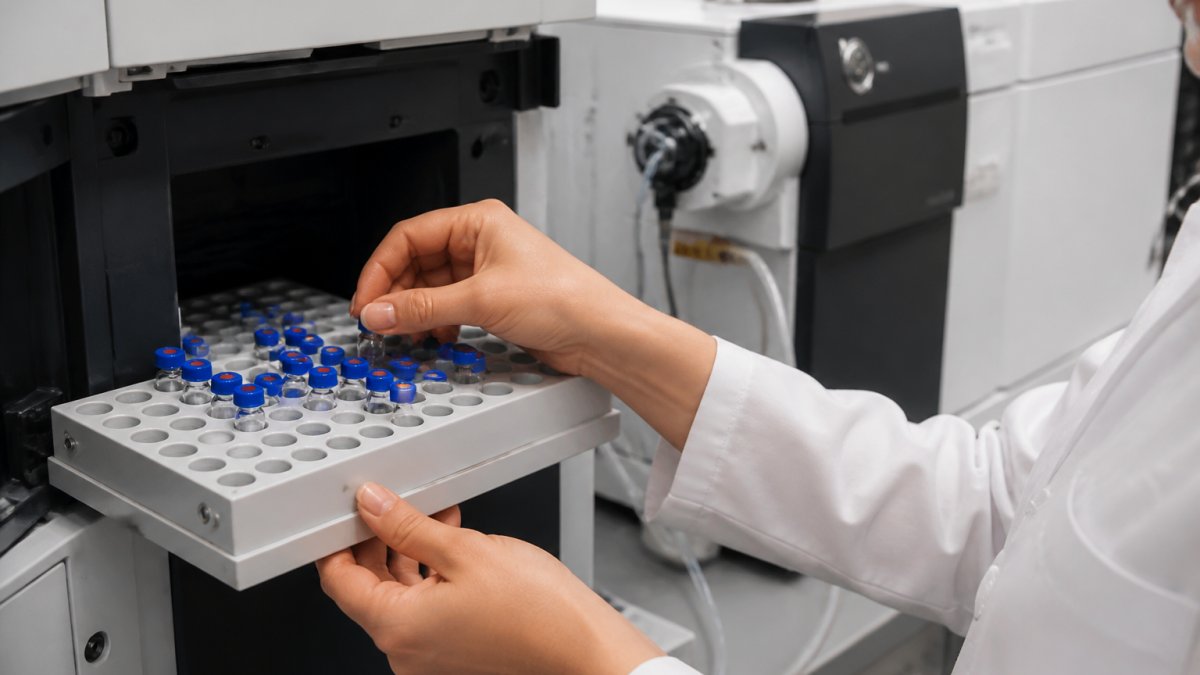
Preparation decides your limit of detection before the instrument is even switched on. Common approaches include protein precipitation, solid-phase extraction, and simple dilution for clean matrices. Internal standards, ideally stable-isotope labelled versions of the analyte, correct for variable recovery and ion suppression. Inject a small, consistent volume and keep the autosampler tray cool if the analyte is unstable.
Chromatographic separation and ionisation
Column chemistry, mobile phase, and gradient shape determine whether your compound of interest elutes cleanly or buried in matrix. A short, sharp peak improves signal-to-noise. Watch for ion suppression where matrix components compete for charge at the source. Retention time stability across the run is your early warning that something has drifted.
MRM detection and data review
Multiple reaction monitoring tracks several transitions per compound. One quantifies, others confirm. Review means checking:
- Retention time against a standard
- Ion ratio against the expected value
- Peak shape and integration boundaries
- Calibration curve fit and blank contamination
HPLC-MS/MS Method Development: The Decisions That Matter
HPLC-MS/MS method development is the process of choosing the transitions, chromatography, and calibration strategy that give you reliable results for your specific matrix. Start with the analyte, not the instrument. Its polarity, molecular weight, and ionisable groups point you toward the right ionisation mode.
Work through these decisions in order:
- Ionisation mode - positive or negative electrospray, or APCI
- Precursor ion - confirm with infusion before touching the column
- Product ions - ramp collision energy and pick two or three
- Chromatography - column, mobile phase, gradient
- Calibration range - matrix-matched where possible
The most common mistake is developing on neat standards and then applying the method to real matrix. Suppression changes everything. Build in time for matrix effects, and validate with spiked samples at low, mid, and high levels.
View the complete research peptide catalogue →
HPLC-MS/MS vs UPLC-MS/MS: Which Fits Your Laboratory?
HPLC-MS/MS vs UPLC-MS/MS comes down to particle size and pressure. UPLC uses sub-2 micrometre particles and higher pressures, delivering sharper peaks and faster runs. HPLC uses larger particles and lower pressures, with wider method transferability and more forgiving maintenance.
| Factor | HPLC-MS/MS | UPLC-MS/MS |
|---|---|---|
| Particle size | 3-5 micrometres | Sub-2 micrometre |
| Run time | Longer | Shorter |
| Peak resolution | Good | Higher |
| Method transfer | Easier | Needs adjustment |
| Solvent use | Higher | Lower |
Neither is universally better. If you run high-throughput screening, UPLC earns its place. If you transfer methods between sites or run a teaching lab, HPLC is often the pragmatic choice. For most research groups, the instrument you can keep running reliably beats the one with the better specification sheet.
Reading an HPLC-MS/MS Chromatogram Without Over-Interpreting It
An HPLC-MS/MS chromatogram shows detector response against retention time, with each transition plotted separately. Reading it well means resisting the urge to treat every peak as a finding.
Check these before you trust a result:
- Does the peak sit at the expected retention time?
- Do the confirming transitions agree with the quantifier?
- Is the signal-to-noise ratio comfortably above the reporting limit?
- Does a blank run show the same peak?
A peak that appears in your blank is contamination, not analyte. A peak with the right mass but the wrong retention time is likely an isomer or interference. And a result below the limit of quantification should be reported as such, not as a number.
Limitations and Common Mistakes in HPLC-MS/MS Work
HPLC-MS/MS has real limits, and knowing them protects your data. Matrix effects can suppress or enhance ionisation in ways that vary between samples. Isomers with identical fragmentation patterns cannot be separated by mass alone. Carryover between injections can inflate low-level results.
The mistakes we see most often:
- Skipping system suitability checks before a batch, then chasing drift mid-run
- Using a degraded reference standard, which shifts every result
- Over-extrapolating the calibration curve beyond the validated range
- Ignoring ion suppression because the neat standard looked perfect
Reference material quality sits underneath all of this. A certificate of analysis that states identity, purity, and batch details lets you trace a problem back to its source. At JGPep+, every product ships with batch-specific COA documentation for exactly that reason, and our catalogue is built for in vitro and analytical research use only.
Running reliable HPLC-MS/MS work depends on documented, traceable materials at every stage. If your reference standards arrive without clear batch records, your results inherit that uncertainty. JGPep+ provides clear product identification, stated vial contents, and a batch-specific Certificate of Analysis with every product, backed by tracked UK dispatch and free delivery on qualifying orders. View the complete research peptide catalogue to compare specifications and documentation before your next method run.
Frequently Asked Questions
What is the difference between HPLC-MS and HPLC-MS/MS?
HPLC-MS separates compounds by liquid chromatography and detects them with a single stage of mass spectrometry, usually reporting a nominal mass. HPLC-MS/MS adds a second fragmentation stage: precursor ions are selected, fragmented in a collision cell and the product ions measured. That extra stage gives much higher selectivity, because two compounds sharing the same mass rarely share the same fragmentation pattern. For peptide and impurity work, HPLC-MS/MS is the more informative technique.
What is HPLC-MS/MS used for in peptide research?
HPLC-MS/MS confirms molecular identity, detects sequence variants and impurities, and supports purity assessment where a chromatogram alone is ambiguous. In analytical method development it is used to quantify trace components and to verify that a batch-specific Certificate of Analysis reflects the material actually supplied. It is a characterisation and detection technique for in vitro and analytical work, not a clinical or diagnostic test.
How do you choose between HPLC-MS/MS and UPLC-MS/MS?
The decision usually comes down to column particle size, pressure limits and throughput. UPLC-MS/MS uses sub-2 micrometres particles and higher pressures, giving sharper peaks and shorter run times, which suits high-sample-number laboratories. HPLC-MS/MS with larger particles is more forgiving of complex matrices and older instrumentation. Check your existing method, detector and service support before switching, since a transfer needs revalidation.
What are the main limitations of HPLC-MS/MS?
Ion suppression from matrix components can reduce signal without any visible chromatographic change, so internal standards and matrix-matched calibration matter. Throughput is lower than UPLC, and method development takes time because transitions, collision energies and mobile phases must be optimised per analyte. The technique also reports what it is set up to detect, so a narrow MRM list can miss unexpected impurities.