 how-to
Minimising Research Delays With UK Suppliers
Table of Contents
- Why Supplier Choice Determines Your Research Timeline
- The Real Cost of Delays: Customs, Communication, and Consistency
- How to Verify Peptide Purity Before You Order
- What a Batch-Specific COA Must Include
- Managing Lead Times for Scientific Research: A Practical Checklist
- Benefits of Sourcing Laboratory Materials Locally
- Common Mistakes That Derail Procurement
- Conclusion: Build a Procurement Process That Protects Your Timeline
- Frequently Asked Questions
Last Updated: September 9, 2026
A single customs hold-up, an inconsistent batch, or a COA that arrives after your experiment has already failed can set a research project back by weeks. For laboratories running time-sensitive studies, minimising research delays with UK suppliers starts long before you place an order: it begins with how you vet who you buy from. This guide focuses on the practical checks that protect your timeline.
The core principle is simple: the supplier you choose determines your research timeline more than any other procurement factor. A domestic source with transparent documentation removes the two biggest delay drivers, customs clearance and verification back-and-forth, before they can touch your schedule. Below, we will show you exactly how to structure your supplier vetting, what documentation to demand, and how to build a procurement process that keeps your experiments moving.
Why Supplier Choice Determines Your Research Timeline
Supplier selection is the single highest-impact decision in your procurement process because every downstream delay, from shipping to quality verification, traces back to it. A supplier that cannot provide batch-specific documentation forces you into a slow, risky verification loop. One that ships from overseas introduces customs clearance variables entirely outside your control.
The most reliable way to protect your timeline is to treat documentation as a pre-order requirement, not a post-delivery courtesy. Ask for the Certificate of Analysis (COA) before you commit funds, and confirm the supplier holds stock for the specific batch you are ordering. This single step eliminates the most common cause of mid-project delay: discovering a purity problem after the goods have arrived.
The Real Cost of Delays: Customs, Communication, and Consistency
Delays rarely come from a single dramatic failure; they accumulate from three predictable sources: customs clearance on international shipments, slow communication during the query phase, and inconsistent batch quality that forces repeat orders.
International shipments introduce the most unpredictable variable. Even with efficient freight forwarding, consignments can be held for inspection, and the documentation required for research materials can trigger additional queries. A domestic supplier removes this entire risk category.
Communication speed matters just as much. When you need to verify a specification or request a batch record, every day of waiting is a day your research stalls. Suppliers that respond within a working day and maintain transparent stock records reduce this friction considerably.
Consistency is the third cost driver. If batch-to-batch purity varies, you will spend time revalidating materials and re-running failed experiments. According to guidance on research material quality from the Royal Society of Chemistry, verifying the provenance and quality of research chemicals is essential for reproducible results.
How to Verify Peptide Purity Before You Order
Verifying peptide purity is the process of confirming that the stated percentage purity on a product label matches the actual chromatographic analysis for your specific batch. This verification must happen before you order, not after delivery.
Purity is typically measured by high-performance liquid chromatography (HPLC), which separates and quantifies the components in a peptide sample. The purity percentage you see on a product page should correspond to the area under the main peak in the HPLC trace, excluding solvent and buffer peaks.
Before ordering, request the following from any supplier:
- The HPLC chromatogram for the specific batch you are purchasing
- The mass spectrometry confirmation of molecular weight
- The storage and handling conditions recommended for that peptide
If a supplier cannot provide batch-specific HPLC data before purchase, treat that as a red flag. A common approach among reliable suppliers is to publish the COA alongside the product listing, allowing you to verify documentation before you commit.
What a Batch-Specific COA Must Include
A batch-specific Certificate of Analysis is a document that reports the quality test results for one identified production batch, linking every analytical measurement to a traceable batch number. This document is your primary evidence that the material meets its stated specification.
A proper COA must include the following elements:
- Product identification: The full product name and catalogue reference
- Batch number: A unique identifier for the specific batch tested
- Stated purity: The chromatographic purity percentage from HPLC analysis
- Test methods: The analytical techniques used, such as HPLC or mass spectrometry
- Date of analysis: When the testing was performed
- Storage conditions: Recommended handling to maintain stability
If any of these elements are missing, the document cannot fully verify your material. A COA that lacks a batch number is effectively useless, because it cannot be linked to the product you receive.
Managing Lead Times for Scientific Research: A Practical Checklist
Managing lead times for scientific research requires a structured approach that accounts for every stage from order to first use in the laboratory. The checklist below converts the principles discussed so far into an actionable procurement routine.
- Verify supplier location: Confirm dispatch occurs from within the UK to avoid customs clearance delays
- Request the batch-specific COA before ordering: Confirm the document matches the batch you will receive
- Confirm stock availability: Ask whether the batch is in stock or made to order
- Check dispatch method: Verify that tracked dispatch is included and confirm the delivery window
- Plan for delivery time: Factor in 2-5 working days for domestic tracked delivery
- Inspect on arrival: Check the batch number on the vial matches the COA batch number
- Store immediately: Follow the recommended storage conditions to preserve stability
Working through this checklist for every order creates a repeatable process. Once established, it reduces the cognitive load of each purchase and ensures no verification step is skipped under time pressure.
| Procurement Stage | Key Action | Timeline Impact |
|---|---|---|
| Supplier vetting | Confirm UK dispatch and COA availability | Eliminates customs risk |
| Pre-order verification | Request batch-specific COA before payment | Prevents post-delivery disputes |
| Order placement | Confirm stock and dispatch method | Sets accurate delivery expectations |
| Post-delivery check | Match vial batch number to COA | Ensures material traceability |
Benefits of Sourcing Laboratory Materials Locally
Sourcing laboratory materials locally offers three concrete benefits for research timelines: predictable delivery, simpler communication, and easier resolution of quality queries. Domestic supply removes customs clearance from your critical path entirely.
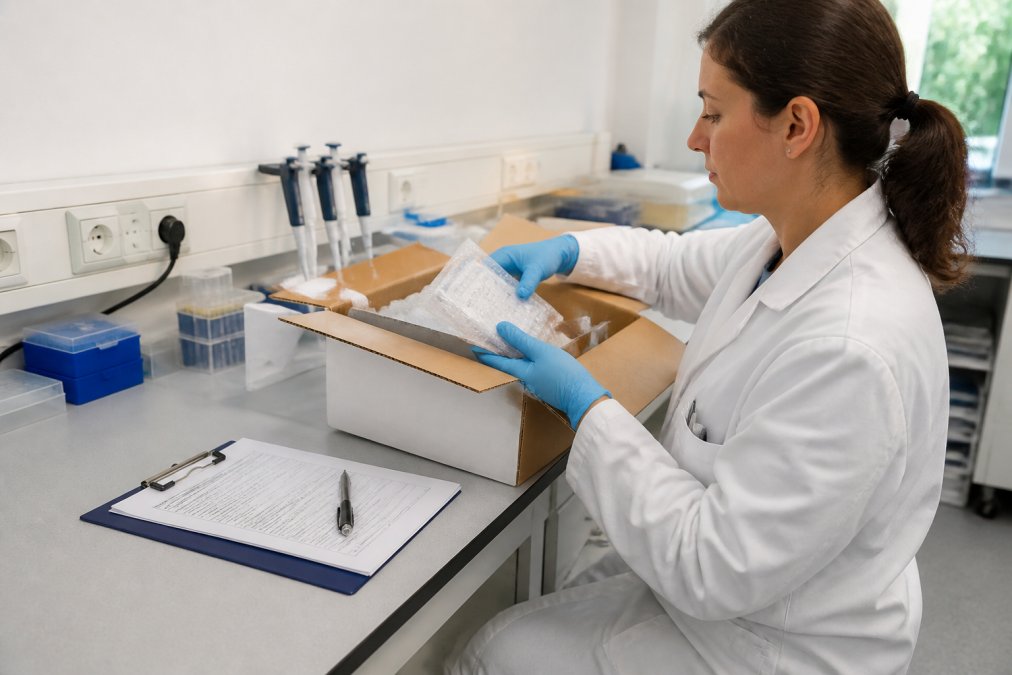
Local sourcing also simplifies the verification process. When a COA query arises, you are dealing with a supplier in the same time zone, which typically means same-day responses rather than waiting for an overseas reply. This responsiveness is difficult to quantify but often determines whether a small query becomes a project-stopping delay.
For laboratories comparing specifications across suppliers, local sourcing makes it practical to request documentation before purchase. A supplier that offers clear product identification and stated vial contents enables a proper appraisal without the friction of international communication. As best practice guidance for laboratory procurement from the Science Council notes, clear specification and traceability are foundations of responsible research practice.
Common Mistakes That Derail Procurement
Most procurement delays trace back to a handful of avoidable mistakes. Recognising these patterns is the first step to preventing them.
Ordering from the cheapest overseas source without checking dispatch location. Low prices often reflect synthesis shortcuts or a lack of quality control, and the customs delay is only the first cost you will bear.
Accepting a generic COA as sufficient. A certificate that does not reference your specific batch provides no verification. You will only discover this when your results become irreproducible.
Assuming batch-to-batch consistency without evidence. Purity can vary between production runs. Always confirm the specific batch you are ordering has been tested to the stated specification.
Failing to confirm stock before ordering. Made-to-order peptides can add weeks to your timeline. If your project is time-sensitive, confirm the batch is physically in stock.
The common thread is a lack of verification before commitment. Suppliers that publish batch-specific COAs and maintain transparent stock records, such as quality assurance frameworks for analytical laboratories from the United Kingdom Accreditation Service, make it straightforward to avoid these errors.
Conclusion: Build a Procurement Process That Protects Your Timeline
Minimising research delays with UK suppliers comes down to building verification into your procurement routine rather than treating it as an afterthought. The supplier you choose, the documentation you demand, and the checks you perform on delivery all determine whether your project stays on schedule.
At JGPep+, we support this process by providing clear product identification, stated vial contents, and a batch-specific Certificate of Analysis for every product, alongside tracked UK dispatch and free delivery on qualifying orders. Our catalogue is designed for lawful in vitro, analytical, and non-clinical research, with transparent GBP pricing that lets you compare materials with full documentation.
Frequently Asked Questions
What are the common causes of supply chain delays in laboratory research?
Customs holds on international shipments are a frequent cause, often adding a week or more to delivery. Poor communication from suppliers about stock levels or dispatch dates also forces last-minute rescheduling. Batch-to-batch inconsistency creates hidden delays: when a new batch fails quality checks, you must reorder and repeat experiments. Vague product documentation slows procurement because lab managers cannot compare specifications quickly. Working with a UK-based supplier that provides clear product identification and batch-specific Certificates of Analysis removes these friction points before they cost you time.
Why does a Certificate of Analysis speed up research workflows?
A batch-specific Certificate of Analysis (COA) lets you confirm purity and quality before you commit to an experiment, rather than discovering a problem after results are compromised. It also simplifies internal quality checks and audit trails, because the documentation matches the exact vial you received. When comparing suppliers, ask whether the COA is specific to your batch or a generic document. Batch-specific documentation means you can verify the stated purity matches the product in hand, reducing the risk of failed runs and the need for repeat orders that extend your timeline.
How does choosing a local supplier impact research project timelines?
A local supplier removes the two largest variables in procurement: customs clearance and long international freight times. Tracked UK dispatch typically means delivery in days, not weeks, and makes it easier to estimate arrival dates for scheduling experiments. If a batch arrives damaged or documentation is incomplete, returns and replacements are faster and less costly. Sourcing locally also simplifies communication, since you are working within the same time zone and regulatory framework. For time-sensitive studies or teaching lab schedules, that predictability directly protects publication deadlines and grant milestones.
Building a procurement process that protects your timeline is not complicated, but it does require discipline. The challenge is resisting the urge to skip verification when deadlines loom. JGPep+ makes that discipline easier by publishing batch-specific COA documentation and dispatching from within the UK with tracked delivery. View the complete research peptide catalogue and see how transparent documentation can keep your research moving.