 comparison
Is In Vitro or In Vivo Documentation Harder to Get Right?
Last Updated: 4 November 2026
Quick Summary
In vitro research is performed outside a living organism, typically in test tubes, flasks or culture dishes, while in vivo research takes place within a whole living organism. In vivo research documentation is harder to get right, because it must also cover animal welfare, dosing and ethics approval.
- In vitro work centres on materials and conditions, such as cell lines, reagent lots and incubator logs.
- In vivo work requires formal animal ethics approval under the Animals (Scientific Procedures) Act 1986.
- Living organisms vary, so in vivo records must capture individual-level data, randomisation and blinding.
- Batch numbers and Certificates of Analysis should be checked against the vial before any experiment begins.
- Reconcile dosing records against animal records at the end of each study week to avoid reproducibility gaps.
Table of Contents
- In Vitro and In Vivo Research: Definitions and Terminology
- Where Each Type of Research Is Conducted and Typical Models
- Key Differences in Documentation: A Side-by-Side Comparison
- In Vitro Study Documentation Checklist and Experimental Protocol Template
- In Vivo Study Documentation Requirements and Reporting Standards
- Batch Number and Certificate of Analysis Documentation for Reproducibility
- Choosing Your Documentation Route and Next Steps for Your Lab
- Frequently Asked Questions
In Vitro and In Vivo Research: Definitions and Terminology
Researchers at UK universities often ask which kind of study needs the tighter paperwork. The answer depends on what your research documentation needs to capture. In vitro research means studies performed outside a living organism, typically in a test tube, flask or culture dish. In vivo research means studies performed within a whole living organism, such as a mouse, a zebrafish or a human volunteer.
The terms come from Latin. In vitro translates as "in glass", a reference to early laboratory glassware, while in vivo means "within the living". Both phrases describe where the experiment takes place, not how the results are interpreted.
Documentation burdens differ between the two. In vitro work is usually simpler to control, which means fewer variables to record. In vivo work introduces biological complexity, so the records must cover animal welfare, dosing and observation in far more detail.
Where Each Type of Research Is Conducted and Typical Models
In vitro studies run in controlled laboratory settings. Common examples include cell culture assays, enzyme kinetics experiments and analytical chemistry tests on peptide purity. A typical setup uses cultured cells in a sterile plate, with known concentrations of a test compound added at defined times.
In vivo studies take place in animal facilities, clinical sites or field settings. Typical models include rodent studies for pharmacokinetics, zebrafish models for toxicity screening and human clinical trials for later-stage research. Each setting brings its own ethical approvals and welfare records.
Many laboratories combine both approaches. An initial in vitro screen narrows the candidates, and only the most promising ones move to in vivo testing. That sequence is also why documentation standards for each stage need to link cleanly.
Key Differences in Documentation: A Side-by-Side Comparison
The table below summarises how documentation requirements differ. It is a general guide, not a substitute for your institution's protocol rules.
| Documentation Element | In Vitro Research | In Vivo Research |
|---|---|---|
| Primary records | Cell line, passage number, reagent lots | Animal strain, age, sex, housing conditions |
| Reagent traceability | Batch number and CoA for every compound | Batch number and CoA plus dosing records |
| Environmental logs | Incubator temperature and CO2 levels | Facility conditions and welfare observations |
| Ethics documentation | Usually minimal | Animal ethics approval and 3Rs justification |
| Reproducibility focus | Exact culture and assay conditions | Biological variability across individuals |
| Retention and audit | Raw data, instrument files and version history | Raw data, welfare records and named attributions |
Most published comparisons stop at that level. The more useful exercise is to map each element to the record you will actually create, who owns it, and where it lives. A template of this kind can be copied into a protocol or electronic lab notebook (ELN) and completed before the first experiment. It works for both study types, with the in vivo column completed only where relevant.
| Record field | In vitro entry | In vivo entry | Owner | Location |
|---|---|---|---|---|
| Study identifier and version | Protocol ID, version, date | Protocol ID, version, date, licence reference | ||
| Test system | Cell line, source, passage number, authentication method | Species, strain, source, age, sex, health status | ||
| Test material | Product name, batch number, CoA reference, storage condition | Product name, batch number, CoA reference, formulation, dosing route | ||
| Controls | Positive and negative controls, vehicle | Vehicle, sham, positive control, randomisation method | ||
| Conditions | Medium, serum lot, temperature, CO2, duration | Housing, enrichment, light cycle, diet, acclimatisation period | ||
| Readouts | Assay, instrument, software version, settings | Observation schedule, humane endpoints, sample handling | ||
| Deviations | Date, description, impact, action | Date, description, impact, action, welfare implication | ||
| Analysis plan | Pre-specified endpoints, exclusion criteria | Pre-specified endpoints, sample size justification, blinding | ||
| Raw data and retention | File name, location, retention period | File name, location, retention period, audit trail |
The key differences can be summarised in a few points:
- Scope of records: In vitro logs centre on materials and conditions; in vivo logs also cover living subjects and welfare decisions.
- Ethics review: In vivo work typically needs formal approval under the Animals (Scientific Procedures) Act 1986, while most in vitro work does not.
- Variability: Living organisms vary, so in vivo records must capture individual-level data, randomisation and blinding.
- Retention and traceability: Both need traceable records, but in vivo studies often carry longer retention requirements and a stronger expectation of an audit trail linking protocol, sample and result.
In Vitro Study Documentation Checklist and Experimental Protocol Template
Good in vitro documentation makes a study repeatable. The following checklist covers the core items most reviewers expect to see in research documentation.
- Cell line or test system identified, with source and passage number
- Culture medium composition and supplier lot numbers recorded
- Compound identity confirmed against the supplier's Certificate of Analysis
- Storage conditions and dates logged for each reagent
- Assay readouts, instrument settings and software versions noted
- Negative and positive controls defined before the experiment starts
- Raw data stored with a dated, traceable record
Building an In Vitro Experimental Protocol Template
A simple template helps you record each experiment consistently. Keep it short enough that researchers actually complete it.
Study title: ___________________ Objective: ___________________ Test system: [cell line / assay type], passage ___ Compound: [name], batch no. ___, CoA reference ___ Concentrations tested: ___________________ Controls: positive ___ / negative ___ Incubation conditions: temperature ___, CO2 ___%, duration ___ Readout and instrument: ___________________ Deviations from protocol: ___________________
Many teams find that filling in the batch and CoA fields first prevents the most common gap in reproducibility, which is missing reagent provenance.
In Vivo Study Documentation Requirements and Reporting Standards
In vivo documentation carries heavier obligations. Researchers in the UK working with animals must follow the Animals (Scientific Procedures) Act 1986 and the Home Office licensing framework. The licence conditions, rather than the Act alone, determine the records you must keep for each project, protocol and personal licence. Institutions also commonly follow the ARRIVE guidelines for reporting animal research, a checklist that covers study design, sample size, randomisation, blinding, inclusion and exclusion criteria, and the reporting of adverse events.
Records typically include the animal strain and source, housing and enrichment details, dosing schedules, humane endpoints and any adverse events. Each observation should be dated and attributed to a named individual. Where a study moves from in vitro screening into animal work, the batch and CoA records for the test compound must carry across unchanged, so that the in vivo data can be traced back to the same material.
A practical record architecture helps satisfy both the licence conditions and the reporting checklist. Most practitioners structure in vivo records in four linked layers:
- Project and protocol layer: the licence reference, protocol version, approved study plan and any amendments, each with an effective date.
- Subject layer: a unique identifier for each animal, its strain, source, age, sex, health status and housing group, linked to the protocol version in force at the time.
- Procedure layer: dated entries for dosing, sampling, observations and welfare checks, each attributed to a named individual and cross-referenced to the subject identifier.
- Outcome and analysis layer: raw data files, the pre-specified analysis plan, any deviations and their impact, and the final report mapped to the ARRIVE checklist items.
This layering matters because it supports traceability in both directions: from a reported result back to the animal and the batch of test material, and from a protocol amendment forward to every subject affected by it. Where an electronic lab notebook or laboratory information management system is used, the audit trail should capture who changed what and when, and raw data should be retained in a form that cannot be altered without a record of the change.
Watch out: incomplete dosing logs are one of the most frequent reasons in vivo results cannot be reproduced, so reconcile the dosing records against the animal records at the end of each study week and record the reconciliation itself.
Reporting standards and regulatory expectations are related but distinct. ARRIVE is a reporting guideline, not a legal requirement, and following it does not by itself satisfy the Animals (Scientific Procedures) Act 1986. Conversely, meeting the licence conditions does not guarantee that a report contains the design and analysis detail a journal or reviewer will expect. Treat the two as parallel obligations: the licence framework governs what you must record and retain, while the reporting checklist governs what you must disclose. Where a study is intended to support a later regulatory submission, check the relevant guidance early, because the expected level of detail in the analysis plan and the raw-data package is usually higher than for an internal report.
Batch Number and Certificate of Analysis Documentation for Reproducibility
Reproducibility depends on knowing exactly which material you used. For practical guidance on keeping batches consistent across repeated experiments, see managing batch consistency in peptide experiments. A batch-specific Certificate of Analysis (CoA) states the identity, purity and quality checks for one production batch, and it is the single most useful document for linking your results to a specific material. To see exactly what a batch-specific CoA contains and how to read it, see batch-specific Certificate of Analysis guide. A generic document that does not match your batch offers far less protection.
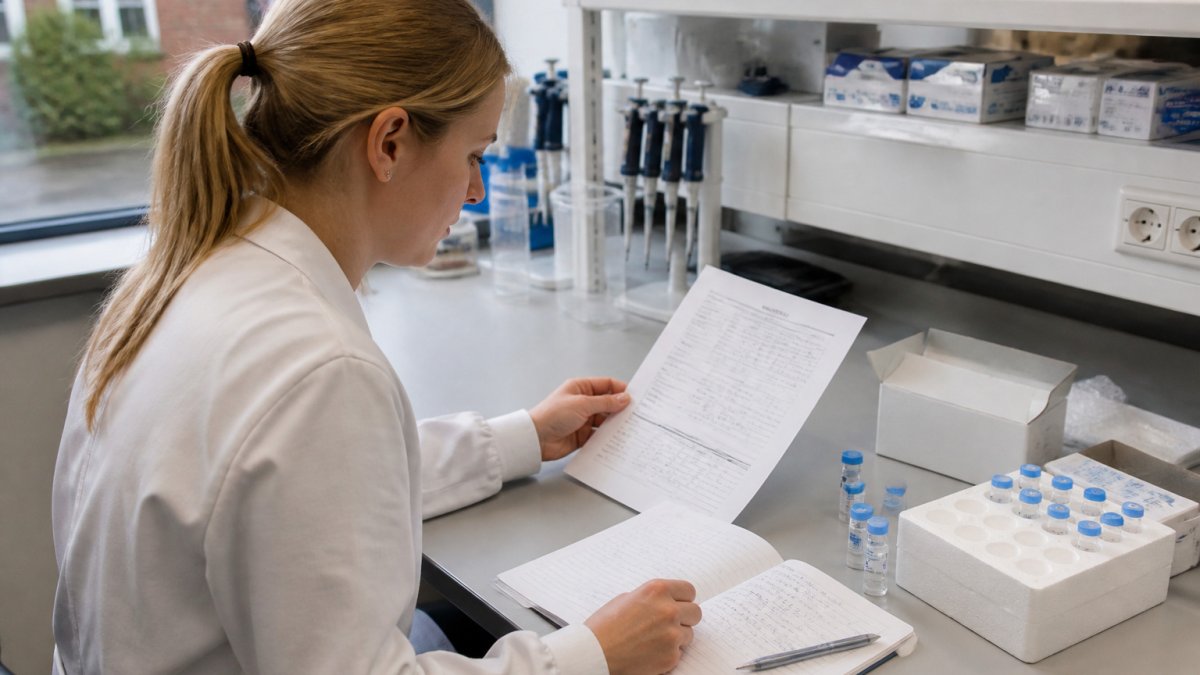
When you record a peptide or reagent in your notebook, log the product name, the batch number and the CoA reference. Check that the batch number on the vial matches the CoA before the material enters an experiment. This simple step is the foundation of reproducible research, and it applies equally to in vitro and in vivo work.
Batch-specific Certificates of Analysis are the documents to check here. Researchers comparing materials can use the CoA for each batch to confirm purity and identity before logging it.
Choosing Your Documentation Route and Next Steps for Your Lab
Neither approach is harder by default. In vitro documentation is lighter on ethics and biological variability, but it still demands careful reagent traceability. In vivo documentation is heavier on welfare and subject-level records, which is why it usually takes more time to get right.
Deciding your documentation route at the protocol stage, not after data collection, is generally sound practice. Start with the checklist and template above, link every reagent to its batch and CoA, and confirm your ethics and reporting obligations before the first experiment begins.
Frequently Asked Questions
What is the difference between in vitro and in vivo research?
In vitro research is carried out outside a living organism, typically in cell cultures, tissue preparations or test tubes and Petri dishes, under tightly controlled conditions. In vivo research studies a whole living organism, such as an animal model or, in clinical settings, a human participant. The documentation burden differs accordingly: in vitro records centre on cell lines, reagents, incubation conditions and assay readouts, while in vivo records must also cover animal welfare, dosing, housing and ethical approval under UK legislation such as the Animals (Scientific Procedures) Act 1986.
What should be documented in an in vitro study?
An in vitro study should record the experimental protocol, the cell line or biological material with its origin and passage number, all reagents with lot numbers, equipment calibration, incubation conditions, raw data, deviations from the protocol and the analysis method. For peptide work, batch numbers and the batch-specific Certificate of Analysis should be filed alongside the experimental record so that the material used can be traced and the purity claimed can be verified.
Why is batch information important in research documentation?
Batch information lets you link a result to the exact material that produced it. If purity or composition varies between batches, unrecorded batch changes can explain otherwise unexplained variation in results. Recording the batch number, supplier, date of receipt and the matching Certificate of Analysis makes the study traceable and supports reproducibility when a colleague or reviewer repeats the work.