 listicle
Identifying Reliable Research Peptide Suppliers UK
Table of Contents
- What Separates Reliable Research Peptide Suppliers UK Buyers Can Trust
- The Importance of COA for Research Peptides: Batch-Specific Evidence, Not a Generic PDF
- HPLC-Verified Peptides UK: How Purity Claims Are Actually Checked
- Supplier Comparison: How Six UK Options Line Up
- Best Peptideslab Alternatives and Comparison Tools Worth Using
- Red Flags, Legal Boundaries, and Common Mistakes in Peptide Procurement
- Frequently Asked Questions
Last Updated: 20 September 2026
What Separates Reliable Research Peptide Suppliers UK Buyers Can Trust
Identifying reliable research peptide suppliers UK laboratories can depend on starts with one document: a batch-specific Certificate of Analysis that matches the vial in your hand. This guide from JGPep+ breaks down how to vet suppliers properly, because the gap between a trustworthy vendor and a costly mistake usually comes down to paperwork, not price.
Most procurement problems trace back to three things: a generic COA that covers no specific batch, purity claims with no chromatogram attached, and overseas dispatch that stalls in customs mid-project. A common mistake is treating a flashy product page as evidence of quality control. It isn't.
Below, we'll show you exactly how to read the documents that matter and spot the red flags. The checklist we cover has helped researchers avoid failed experiments caused by inconsistent batches.
The Importance of COA for Research Peptides: Batch-Specific Evidence, Not a Generic PDF
The importance of COA for research peptides cannot be overstated: a Certificate of Analysis is the document that ties a specific batch number to its measured purity, identity, and test method. Without a batch number, it proves nothing about what you received.
What a usable certificate actually contains
A usable COA should include the batch or lot number, the test method used (typically HPLC), the measured purity percentage, the molecular mass, and the date of testing. Many suppliers issue a single templated PDF that applies to every order. That document cannot confirm anything about your specific vial.
Ask for the batch-specific document first. A supplier confident in their quality control will send it without hesitation.
HPLC-Verified Peptides UK: How Purity Claims Are Actually Checked
HPLC-verified peptides UK suppliers refer to are checked using High-Performance Liquid Chromatography, a method that separates the components of a sample and measures how much of the target peptide is present. The result is a chromatogram: a graph with a main peak for your peptide and smaller peaks for impurities.
Reading a chromatogram without a chemistry degree
You do not need to interpret every peak. Focus on three things: the retention time of the main peak, the percentage area it occupies, and whether smaller impurity peaks are visible nearby. A main peak at 98% or above, with minimal secondary peaks, indicates a clean synthesis.
What most guides miss is that a purity figure alone is meaningless without the method behind it. "99% pure" on a product page tells you nothing if no chromatogram is supplied. Ask for the trace, not just the number.
For independent guidance on analytical methods, the United States Pharmacopeia general chapters publishes recognised standards for chromatographic testing that many laboratories reference.
Supplier Comparison: How Six UK Options Line Up
Suppliers differ most in documentation transparency and dispatch reliability. Here is how they compare on the factors that matter for laboratory procurement.
| Supplier | COA Approach | Dispatch | Pricing Visibility | Best For |
|---|---|---|---|---|
| JGPep+ | Batch-specific COA per product | Tracked UK dispatch | Transparent GBP pricing | Most research labs |
| Tide Labs | UKAS-verified HPLC testing | Same-day before 4pm | On enquiry | Cold-chain requirements |
| Imperial Peptides UK | Transparent batch reporting | Domestic shipping | On enquiry | Quick turnaround |
| UK Peptides | Verified research-grade standards | Next-day delivery | On enquiry | Urgent orders |
| Bachem | Large-scale manufacturing | Institutional logistics | Custom quote | Large institutional projects |
| Peptides Lab UK | HPLC-verified purity | Standard UK shipping | On enquiry | Niche compound research |
JGPep+
Every product carries clear identification, stated vial contents, and an accessible batch-specific COA, so you can verify purity records before and after ordering. Pricing is listed in GBP with free delivery on orders over £100, and dispatch is tracked within the UK. The catalogue is built for in vitro and analytical work rather than large-scale synthesis, which suits most academic and teaching labs but not industrial volume buyers.
Rated 4.0 out of 5 from 4 reviews on Trustpilot.
Tide Labs
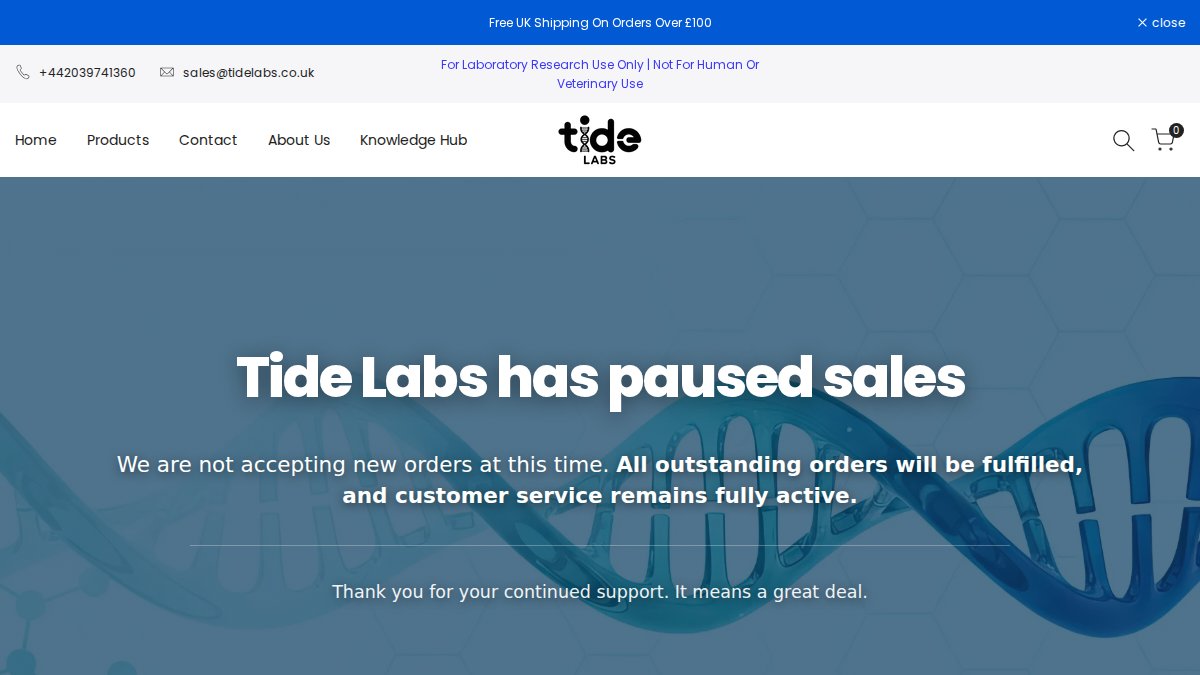
Tide Labs leans hard into cold-chain logistics, storing stock at -20°C and using Type 1 glass vials to protect sample integrity. Their UKAS-verified HPLC testing is a genuine strength. The drawback: pricing is not listed online, so you must enquire before you can budget, which slows procurement.
Imperial Peptides UK
A domestic supplier with a clear focus on transparent batch reporting and fast shipping. Where it falls short is public pricing information, which means comparing costs across orders takes extra correspondence.
UK Peptides
Speed is the selling point here, with next-day delivery across the UK and global shipping options. If you need materials tomorrow, this is a sensible route. Pricing requires direct enquiry, so plan ahead for budget approval.
Bachem
A global peptide manufacturer with decades of synthesis experience and full CDMO support. The scale is impressive, but it is aimed at large institutional and commercial clients. For a small teaching lab, it is overkill both in minimums and in process.
Peptides Lab UK
Specialises in specific compounds for hormonal and metabolic research pathways. The niche catalogue is useful if your work sits in that space, but the focused range means fewer options if your project spans multiple compound families.
Best Peptideslab Alternatives and Comparison Tools Worth Using
If you want to vet suppliers before committing, several comparison platforms do the legwork.
Use these to shortlist, then request batch-specific COAs directly from each candidate. The comparison site narrows the field; the documentation makes the final call.
Red Flags, Legal Boundaries, and Common Mistakes in Peptide Procurement
The biggest mistakes in peptide procurement are procedural, not financial. Watch for these warning signs before you place an order:
- No batch number on the COA, or a generic document reused across orders
- Purity claims with no chromatogram supplied on request
- Prices far below the market with no explanation of the synthesis method
- Overseas dispatch with no customs plan, risking week-long delays mid-project
- No stated returns or replacement process if a batch does not match its COA
- Vague product names with no catalogue reference, strength, or nominal amount
On the legal side, research peptides are not medicines and are not intended for human or veterinary use. Buyers should confirm that materials are supplied for lawful in vitro, analytical, or educational work only. The Medicines and Healthcare products Regulatory Agency guidance sets out how medicinal claims are regulated in the UK, and reputable suppliers keep their catalogues clearly on the research side of that line.
A common mistake is prioritising price over documentation. A cheaper vial with no batch traceability costs far more when an experiment fails and the batch cannot be verified.
Frequently Asked Questions
What documentation should a reputable peptide supplier provide?
At minimum, a batch-specific Certificate of Analysis (COA) that matches the lot number on your vial, plus stated vial contents, nominal amount, and a catalogue reference. The COA should list the analytical method used, typically HPLC, and report a purity figure for that specific batch rather than a generic specification. Suppliers who only publish a sample COA, or who cannot tie documentation to the batch you receive, make verification impossible. Ask to see the COA before ordering.
Why is a batch-specific Certificate of Analysis essential for research?
Peptide purity varies between synthesis runs, so a specification sheet proves nothing about the vial in your hand. A batch-specific COA lets you confirm that the material you are about to use in an assay matches the purity and identity you planned around. Without it, results become hard to reproduce and reviewers may question your methods. Keep the COA alongside your lab records so any future audit or publication query can be answered directly.
How do I verify the purity of research peptides?
Start with the COA and check that the reported purity comes from HPLC analysis of that batch. Look for the method details, the retention time, and the purity percentage, and confirm the batch number matches your vial label. Where a supplier offers HPLC-verified peptides, ask whether chromatograms are supplied alongside the certificate. If you have in-house analytical capacity, running your own HPLC check on receipt is the strongest confirmation, particularly for long-running studies.
Are research peptides legal for human consumption in the UK?
Research peptides sold for laboratory use are not medicines and are not authorised for human or veterinary consumption. Selling or supplying them for human use falls under UK medicines regulation, and the MHRA is the relevant regulator for anything presented as a medicine. Legitimate suppliers state clearly that products are for in vitro, analytical, and non-clinical research only. If a supplier markets peptides with dosing advice or health claims, that is a serious warning sign.
What are the risks of using low-quality research peptides in laboratory experiments?
Impure or misidentified material can invalidate an entire study. If a batch is 85% pure when you assumed 99%, your concentration calculations are wrong and your results may not be reproducible. Contaminants can also interfere with analytical methods or damage sensitive equipment. The cost of repeating an experiment, or losing a publication timeline, usually outweighs any saving from a cheaper supplier. Batch consistency matters as much as headline purity.
Procurement gets difficult when suppliers hide behind generic documents and unclear pricing. JGPep+ was built to remove that friction, offering clear product identification, a batch-specific Certificate of Analysis for every product, tracked UK dispatch, and transparent GBP pricing with free delivery on orders over £100. If you are tired of chasing paperwork, view the complete research peptide catalogue and compare materials with documentation you can actually verify.