 listicle
UK Peptide Suppliers: 9 Verified Options for Labs
Table of Contents
- How to Compare UK Peptide Suppliers
- 1. JGPep+: Batch-Specific COA Documentation
- 2. Tide Labs: UKAS-Verified HPLC Testing
- 3. UK Peptides: Next-Day Domestic Delivery
- 4. Imperial Peptides UK: Tracked 24 Logistics
- 5. Pure Peptides UK: Community-Vetted Reliability
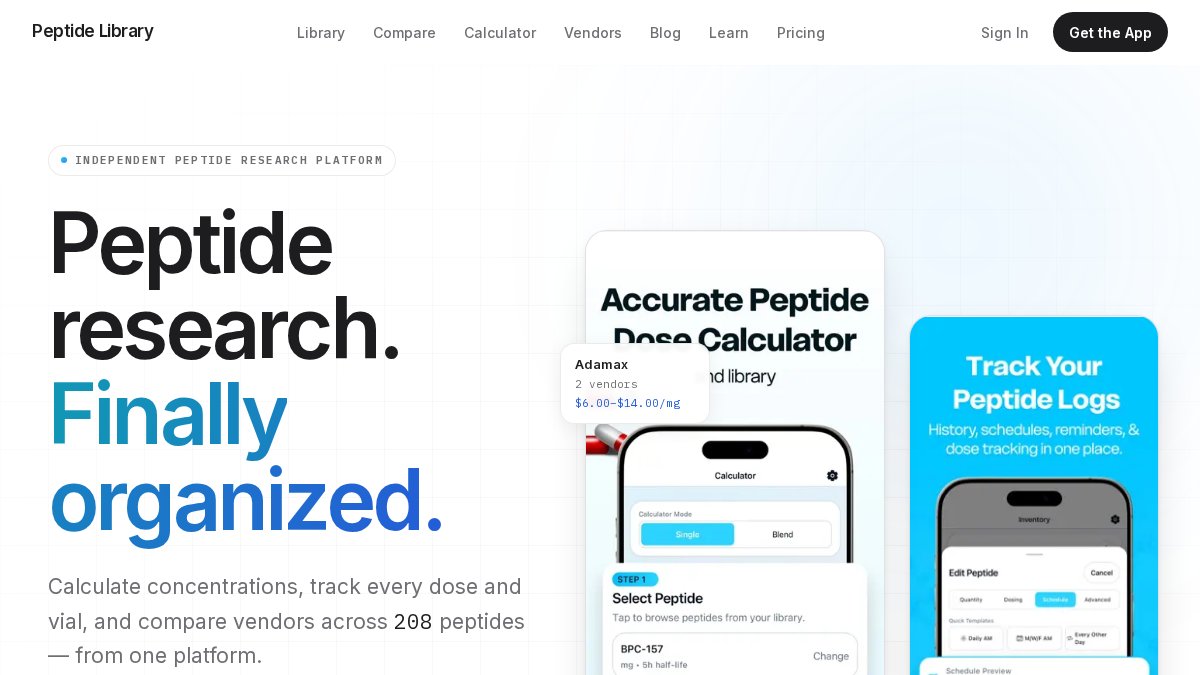
- 6. Peptide Library: Comparison and Calculation Tools
- 7. Bluewell Peptides: Forum-Recommended Supply
- Why Documentation Beats Marketing Claims
- Frequently Asked Questions
Last Updated: October 4, 2026
How to Compare UK Peptide Suppliers
Choosing between UK peptide suppliers comes down to documentation you can verify, not marketing claims. This guide from JGPep+ focuses on the importance of verifiable documentation when choosing a supplier for laboratory research. Every supplier here serves lawful in vitro and analytical work, so the deciding factor is traceability: can you check the batch record before you commit, and does the paperwork match the vial in your hand?

When we assessed peptide suppliers for this comparison, three criteria separated the strong from the weak. A Certificate of Analysis is a batch-specific document reporting a compound's identity, purity, and analytical method for that exact production run. Without one tied to your batch number, you are trusting a claim rather than verifying it.
Below, we break down what to check before ordering. JGPep+ provides batch-specific COA documentation and transparent GBP pricing.
COA Access and Analytical Verification
COA access is the single most important differentiator between peptide suppliers. A useful certificate names the batch number, test method, and purity figure for that specific lot, not a generic specification sheet reused across orders.
Look for HPLC (high-performance liquid chromatography) data showing a purity percentage and retention time, plus mass spectrometry confirming molecular weight. Suppliers using UKAS-accredited laboratories give you an independent verification chain rather than an in-house claim. UKAS is the national accreditation body recognised by government to assess testing laboratories.
Pricing Transparency and Delivery Terms
Pricing transparency separates professional suppliers from those who hide figures behind a login. Listed GBP prices let you budget accurately and compare like for like across nominal amounts.
Delivery terms matter just as much for research timelines. Tracked domestic dispatch avoids the customs delays that can derail a publication deadline. Free delivery thresholds, typically around the £100 mark, reward larger orders.
| Supplier | Starting Price | COA Approach | Delivery | Best For |
|---|---|---|---|---|
| JGPep+ | See pricing page | Batch-specific COA | Tracked UK dispatch | Verifiable documentation |
| Tide Labs | £19.99/vial | UKAS-verified HPLC | Cold chain, free over £100 | Temperature-sensitive work |
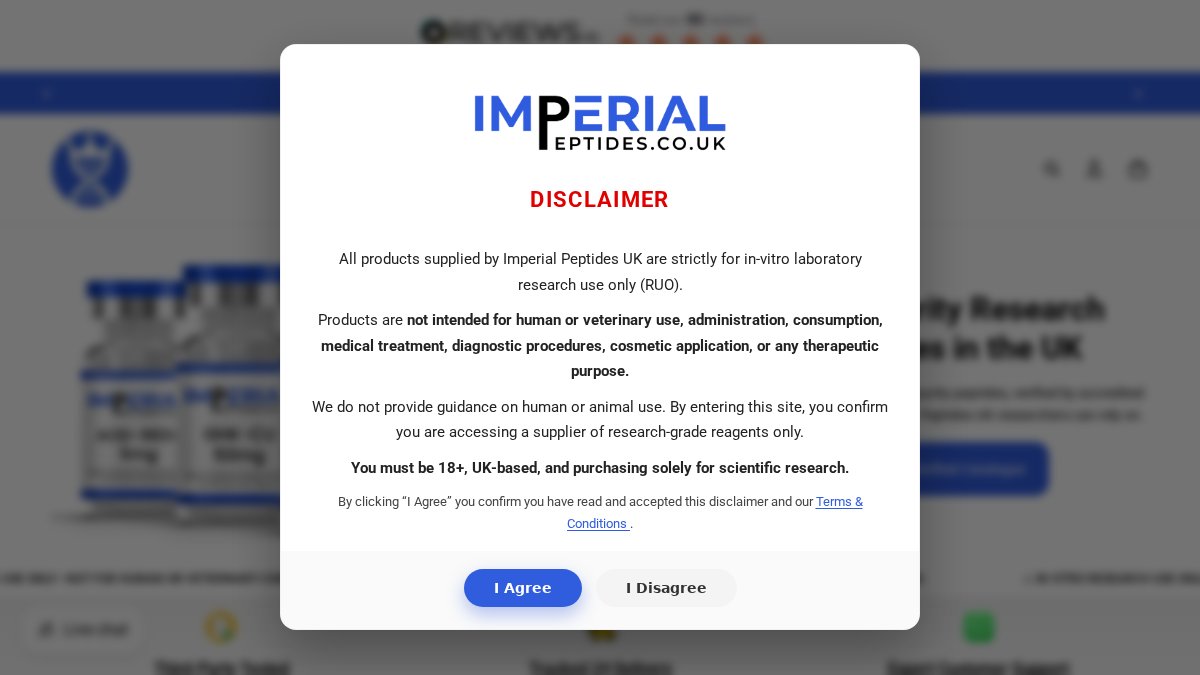
| UK Peptides | £69.00/vial | Standard COA | Next-day UK | Fast turnaround |
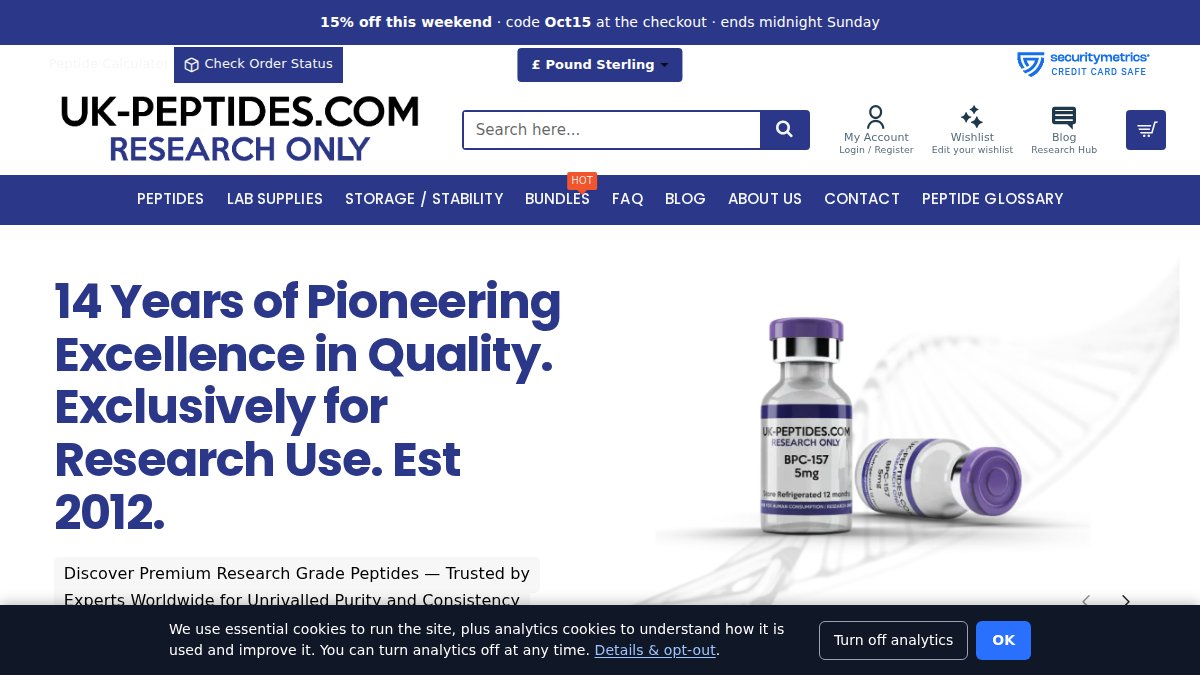
| Imperial Peptides UK | Contact for pricing | Standard COA | Tracked 24, free over £99 | Domestic speed |
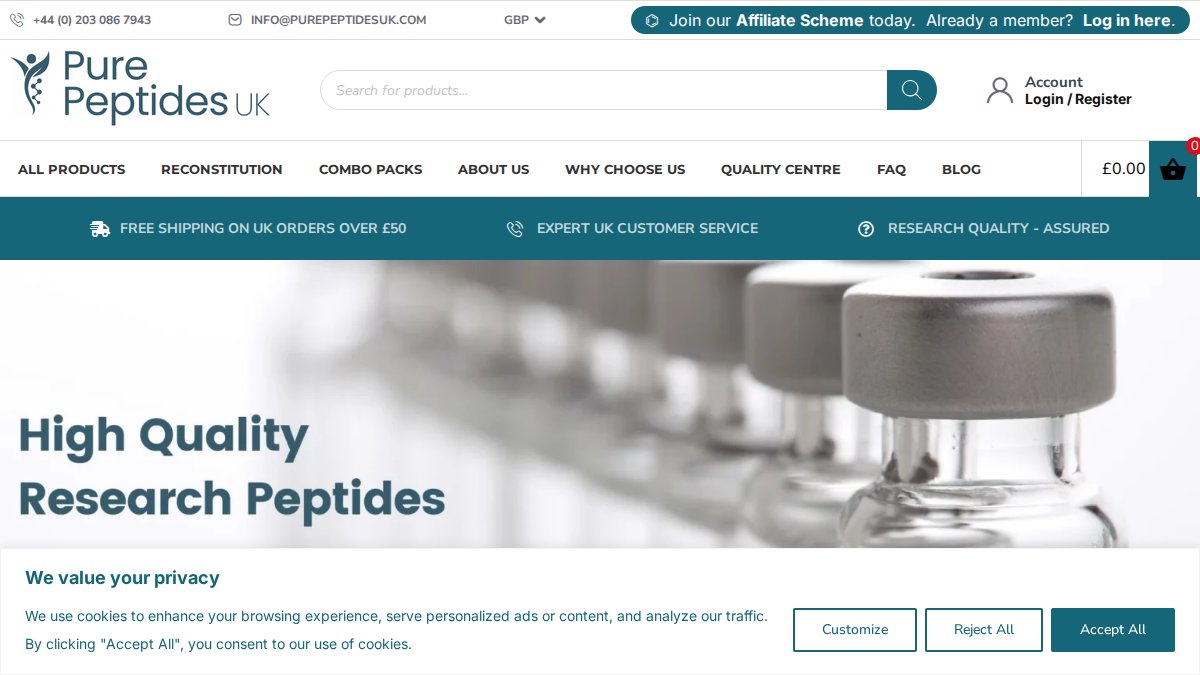
| Pure Peptides UK | Contact for pricing | Standard COA | Standard UK | Community-vetted |
| Peptide Library | Free | N/A (tool) | N/A | Comparison and calculation |
| Bluewell Peptides | Contact for pricing | Standard COA | Standard UK | Forum-recommended |
| Vitality Peptides | Contact for pricing | Standard COA | Standard UK | Long-term supply |
| Oxford Peptides | Contact for pricing | Technical docs | Standard UK | Synthesis quality |
1. JGPep+: Batch-Specific COA Documentation
JGPep+ provides a batch-specific Certificate of Analysis for every product, so you can match the certificate to your vial rather than relying on a blanket specification.
The catalogue states clear product identification and stated strengths, which makes proper appraisal across suppliers possible. Transparent GBP pricing removes the guesswork, and tracked UK dispatch keeps timelines predictable. Free delivery applies on orders over £100.
2. Tide Labs: UKAS-Verified HPLC Testing
Vials use Type 1 hydrolytic glass, and full -20°C cold chain storage protects compounds in transit. The trade-off is cost: starting around £19.99 per vial, it sits above budget suppliers. Free UK shipping applies over £100.

3. UK Peptides: Next-Day Domestic Delivery
Pricing starts around £69.00 per vial, and the full catalogue is not always transparently priced, so confirm figures before ordering. An established market presence gives it a track record, though documentation is standard rather than batch-forward.
View the complete research peptide catalogue →
4. Imperial Peptides UK: Tracked 24 Logistics
The compounds are research-grade, and support is aimed at laboratory researchers. The drawback is pricing: figures are not consistently listed, so you may need to enquire directly before you can compare costs.
5. Pure Peptides UK: Community-Vetted Reliability
Specific pricing requires cart interaction or an account, which slows comparison. Stock availability is generally good. If peer feedback matters more to you than published documentation depth, it is worth a look.
6. Peptide Library: Comparison and Calculation Tools
Its vendor price comparison engine centralises data from multiple suppliers, and concentration calculation tools help with method development. It does not sell peptides directly, so it complements rather than replaces a supplier. The free tier makes it easy to trial.
7. Bluewell Peptides: Forum-Recommended Supply
The honest limitation is digital: it lacks the modern e-commerce interface of larger firms, so ordering and price-checking feel dated. For researchers following community-vetted lists, that trade-off is often acceptable.
Why Documentation Beats Marketing Claims
A COA is only useful if it is batch-specific. Generic certificates that list a purity figure without a batch number tell you nothing about the vial in your hand. When you compare peptide suppliers, ask for the certificate tied to your exact lot before you order.
Storage matters too. Most research peptides need cold storage, and freeze-thaw cycles degrade them. Suppliers with cold chain logistics protect the compound from synthesis to your bench.
For guidance on laboratory quality standards, the UKAS laboratory accreditation information explains how independent testing verification works. The MHRA guidance on laboratory materials sets out the regulatory context for research supply.
Frequently Asked Questions
How do I verify the quality of research peptides?
Request a batch-specific Certificate of Analysis (COA) from your supplier. The COA should show HPLC purity results, mass spectrometry confirmation, and the specific batch number matching your vial. Reputable UK peptide suppliers provide this documentation before purchase. Check that the testing method is stated and that purity is typically 95% or higher for research-grade material. If a supplier only offers generic COAs or refuses to share batch records, treat that as a warning sign.
What is a Certificate of Analysis (COA) for peptides?
A COA is a document confirming the identity, purity, and composition of a specific peptide batch. It typically includes the batch number, molecular weight, HPLC purity percentage, MS confirmation, and storage recommendations. When you buy research grade peptides, the COA should match your vial's batch number exactly. This allows you to verify that what you received matches what was tested. Suppliers like JGPep+ provide batch-specific COAs as standard, not generic documents.
Are research peptides legal for purchase in the UK?
Research peptides intended for in vitro and analytical use are legal to purchase in the UK when sold for laboratory research purposes only. They are not medicines and must not be sold or marketed for human or veterinary consumption. Suppliers should clearly state that products are for research use only. Check that your supplier operates within UK regulations and provides proper documentation. If a supplier markets peptides for human use, that falls outside legitimate research supply.
How should research peptides be stored in a laboratory setting?
Most lyophilised peptides require storage at -20°C for long-term stability, though some are stable at 2-8°C. Follow the storage guidelines for laboratory peptides provided on the COA or product documentation. Keep vials sealed and protected from light and moisture. Once reconstituted, store at 2-8°C and use within the timeframe stated by the supplier. Avoid repeated freeze-thaw cycles, as these degrade peptide integrity. Label vials with receipt date and batch number for traceability.