 how-to
How to Source Research Chemicals in the UK: 2026 Guide
Table of Contents
- What You'll Need Before You Start Sourcing
- Understanding the Rules on Research Chemicals
- Step 1: Use a Research Chemical Supplier Checklist
- Step 2: Read the Research Chemicals Certificate of Analysis
- Step 3: Plan Your Research Chemical Purity Testing
- Step 4: Place the Order and Manage Delivery
- Step 5: Follow Research Chemical Storage and Handling Rules
- Common Mistakes to Avoid When Sourcing Research Chemicals
- Frequently Asked Questions
Last Updated: October 17, 2026
What You'll Need Before You Start Sourcing
Learning how to source research chemicals in the UK starts with three things: a clear research purpose, a documented procurement trail, and a supplier who will show you the paperwork before you pay. This guide from JGPep+ walks through the full process, from the first checklist to safe storage after delivery. It is written for laboratory professionals who need materials with traceable documentation, not guesswork.
Before you contact anyone, get your house in order. The groundwork you do now decides whether your order runs smoothly or stalls.
Here is what to have ready:
- A written research rationale for each material you need
- Your institution's internal approval or sign-off record
- A named person responsible for receipt and storage
- A purchase order or approved budget line
- Your COA requirements written down before you enquire
Most delays we see come from missing paperwork, not from supply problems. Sort the admin first and the rest follows.
Understanding the Rules on Research Chemicals
Research chemicals sit inside a patchwork of UK rules, and no single law covers them all. The correct approach is to check each material against the relevant UK legislation before you buy, and to keep records that show you did.
Three areas matter most for laboratory buyers:
- Consumer protection and supply law. Suppliers must describe products accurately and sell goods that match their description. The Competition and Markets Authority guidance on unfair commercial practices sets out what counts as misleading.
- Workplace safety. The Control of Substances Hazardous to Health Regulations require employers to assess risk and control exposure. The HSE guidance on COSHH explains how this applies in labs.
- Chemical and poisons controls. Some substances face extra restrictions under UK chemical and poisons legislation. Check the current position for each material rather than assuming.
A key point most guides skip: the burden of due diligence sits with you, the buyer, as much as with the supplier. A clear COA and an accurate product description are your evidence trail.
Step 1: Use a Research Chemical Supplier Checklist
A research chemical supplier checklist is a short set of questions you ask every supplier before ordering. It separates serious suppliers from the ones who only look serious.
Run through these before you commit:
- Can they show a batch-specific COA before purchase?
- Is the product identified clearly, with stated strength and nominal amount?
- Do they quote prices in GBP with delivery terms shown?
- Is dispatch tracked, and is the courier named?
- Do they state clearly that products are for research use only?
- Is there a named contact for documentation queries?
- Do they describe their returns or replacement process?
Documentation and Traceability Checks
Traceability is the difference between a material you can defend in a report and one you cannot. Ask for the batch number, the analysis date, and the storage conditions on record. If a supplier cannot tie a document to a specific batch, treat that as a red flag. At JGPep+, every product carries clear identification and a batch-specific COA, so you can check records before you order rather than after.
Step 2: Read the Research Chemicals Certificate of Analysis
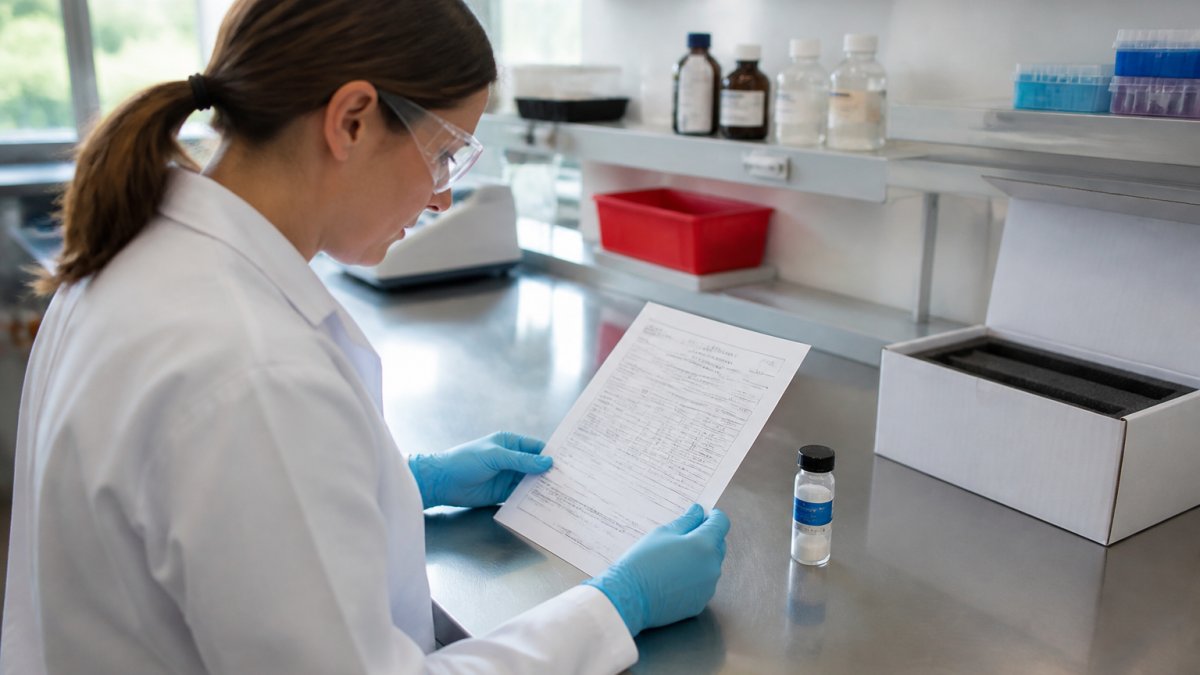
A research chemicals Certificate of Analysis is the supplier's formal record of what a specific batch contains and how it was tested. Reading it properly is the single most useful skill in sourcing.
Do not skim it. Read it against the product page, line by line.
What a Genuine COA Should Contain
A genuine COA should contain the following, and it should match the product you are buying:
- The product name and batch or lot number
- The stated strength and nominal vial contents
- The analytical methods used, such as chromatographic purity testing
- The measured result for each method, not just a target figure
- The analysis date and, where relevant, a retest date
- Storage conditions and any handling notes
- A clear statement that the material is for research use only
Step 3: Plan Your Research Chemical Purity Testing
Research chemical purity testing is how you confirm that what arrived matches what the COA claims. Even with a good supplier, your own verification closes the loop.
Plan this before delivery, not after. A simple approach:
View the complete research peptide catalogue →
- Decide which analytical method you will use for confirmation.
- Book instrument time or reagent stocks in advance.
- Record the batch number and arrival date on receipt.
- Run your check and file the result with the COA.
- Flag any discrepancy to the supplier immediately.
Keep your own results alongside the supplier's documents. If a batch ever comes into question, that combined record is what protects your work.
Step 4: Place the Order and Manage Delivery
Placing the order is the easy part. Managing delivery well is where careful buyers pull ahead. Confirm the dispatch method, the tracking details, and who will sign for the parcel.
A few practical points:
- Ask for tracked dispatch so you can follow the parcel.
- Give a delivery address where someone can receive it during working hours.
- Check the packaging on arrival for damage before signing.
- Store materials correctly the same day they arrive.
JGPep+ offers tracked UK dispatch and free delivery on qualifying orders, which removes the customs uncertainty that slows overseas supply. GBP pricing means the figure you see is the figure you pay.
Step 5: Follow Research Chemical Storage and Handling Rules
Research chemical storage and handling rules exist for two reasons: to protect the material and to protect you. Get them wrong and your results, not just your samples, are at risk.
- Store materials at the temperature stated on the COA.
- Keep vials sealed and labelled at all times.
- Use appropriate personal protective equipment when handling.
- Record storage location and conditions in your log.
- Check stock periodically against retest dates.
Your COSHH assessment should already cover handling and spill response. If it does not, update it before the material arrives.
Common Mistakes to Avoid When Sourcing Research Chemicals
The same mistakes come up again and again. Avoiding them saves time, money, and rework.
- Buying on price alone. A cheap quote with vague documentation costs more in the long run.
- Accepting a generic COA. If it is not batch-specific, it proves nothing about your material.
- Skipping your own purity check. The supplier's word is a starting point, not the final answer.
- Ordering without a named custodian. Unclaimed parcels get lost or mishandled.
- Ignoring retest dates. Old stock can quietly undermine a whole project.
What most guides miss about how to source research chemicals in the UK is that sourcing is a documentation exercise as much as a purchasing one. Treat it that way and the process becomes routine.
| Step | What You Do | Why It Matters |
|---|---|---|
| 1 | Run the supplier checklist | Filters out weak suppliers early |
| 2 | Read the batch COA | Confirms identity and purity claims |
| 3 | Plan your own purity testing | Verifies what actually arrived |
| 4 | Manage tracked delivery | Prevents loss and customs delays |
| 5 | Store and handle correctly | Protects material and people |
Frequently Asked Questions
How do you check whether a research chemical supplier is reputable?
Work through a research chemical supplier checklist: confirm the company has a verifiable business address and contact details, check that it publishes batch-specific Certificates of Analysis rather than generic documents, and look at independent reviews such as Trustpilot. Ask whether it provides clear product identification, stated vial contents and catalogue references. A supplier that answers documentation questions directly and promptly is usually a safer choice than one that deflects them. Avoid any seller whose prices look far below the market or who cannot explain how it tests its batches.
What should a Certificate of Analysis include?
A research chemicals Certificate of Analysis should name the specific batch, the product and its stated strength, the analytical methods used and the results for identity and purity. Look for a unique batch or lot number, a testing date, and the name of the laboratory that carried out the work. Chromatography results, such as HPLC traces with retention times and peak areas, are a good sign. The document should match the vial you receive. If the COA is undated, lacks a batch number or only lists vague product names, treat it as unusable for research records.
How can you verify the identity and purity of a research chemical?
Start with the supplier's batch-specific COA, then confirm identity in your own lab using an appropriate method such as HPLC, mass spectrometry or NMR, depending on your equipment and protocol. Run a small pilot check on a new batch before committing it to a full study. Keep your own records of retention times and peak areas so you can spot batch-to-batch variability. If results fall outside your acceptance criteria, raise it with the supplier before using the material in further work.
Are research chemicals intended for human use?
No. Research chemicals supplied for laboratory work are intended for in vitro, analytical and non-clinical research only. They are not medicines and are not intended for human or veterinary use. If you are sourcing materials for a lab, make sure your procurement records, storage and disposal procedures reflect that status. Anyone buying research chemicals for personal consumption is outside the intended use and may also be breaking the law, depending on the substance and its classification under UK misuse of drugs legislation.
Sourcing well takes discipline, but the payoff is research you can stand behind. If you want a supplier who puts documentation first, JGPep+ provides clear product identification, a batch-specific COA for every product, and tracked UK dispatch with free delivery on qualifying orders over £100. View the complete research peptide catalogue and start your next order with the paperwork already in place.