 how-to
How to Order Peptides Online: A UK Lab Guide
Table of Contents
- Why Ordering Peptides Online Requires More Care Than a Standard Lab Supply
- How to Verify a Peptide Supplier Before You Place an Order
- What a Peptide Certificate of Analysis Should Actually Tell You
- Your Peptide Order Checklist: What to Confirm Before You Pay
- How to Order Peptides Online: A Step-by-Step Process
- What to Check When Your Peptide Order Arrives
- Common Mistakes When Ordering Research Peptides
- Frequently Asked Questions
Last Updated: 13 October 2026
Why Ordering Peptides Online Requires More Care Than a Standard Lab Supply
A peptide order online is not the same as restocking gloves or pipette tips. When you order peptides, you are buying a material whose identity, purity and documentation determine whether your in vitro work stands up to scrutiny. This guide from JGPep+ walks through how to order peptides online with the rigour your research deserves.
The stakes are practical, not theoretical. If a supplier ships a batch whose Certificate of Analysis does not match the vial, you lose weeks of analytical work and possibly a publication deadline. Many laboratories find that the verification step they skip is the one that costs them most.
Below, we break down supplier verification, COA interpretation and a payment-ready checklist so you can order peptides with confidence.
The Difference Between Research Materials and Medicines
Research peptides are laboratory materials. They are not medicines, and they are not licensed for human or veterinary use.
That distinction shapes everything about how you order peptides. A licensed medicine comes with a marketing authorisation, a pharmacy supply chain and a regulator overseeing every batch. A research peptide arrives with a COA and your own judgement about whether the supplier is trustworthy.
The Medicines and Healthcare products Regulatory Agency (MHRA) governs what can legally be sold as a medicine in the UK. If a supplier markets peptides with dosing instructions or health claims, that is a warning sign, not a feature. Legitimate research supply stays firmly on the laboratory side of that line.
How to Verify a Peptide Supplier Before You Place an Order
Supplier verification comes down to three things: documentation, transparency and track record. Ask for a batch-specific COA before you pay, check that the company publishes clear product identification, and look for evidence that other laboratories use them.
Our own approach at JGPep+ is to publish a batch-specific Certificate of Analysis for every product, with stated vial contents and clear catalogue references. That is the standard we would hold any supplier to.
When you order peptides, a short verification routine saves enormous time later:
- Request the COA for the exact batch you will receive, not a sample document
- Confirm the catalogue number, nominal amount and stated strength are listed
- Check the company has a UK presence and tracked dispatch
- Look for independent reviews or references from other laboratories
- Confirm a returns or replacement process exists if documentation does not match
Red Flags That Signal an Unreliable Supplier
Certain patterns should stop you before payment. A generic COA reused across every product is the most common. If the document has no batch number, no test date and no laboratory name, it tells you nothing about what is in the vial.
Other warnings:
- Prices dramatically below every other supplier, with no explanation
- Pressure to pay by untraceable methods
- No physical address or company registration details
- Health or dosing claims anywhere on the site
- Reluctance to share documentation before purchase
What a Peptide Certificate of Analysis Should Actually Tell You
A peptide Certificate of Analysis is a document that records the test results for one specific batch of material, including its identity, purity and the methods used to confirm them.
A useful COA contains the batch number, the date of testing, the analytical methods used, and the results for each. Look for a purity figure from chromatographic analysis, a confirmed molecular mass, and a clear statement of what the material is.
Generic documentation is the problem. A COA that lists no batch number, or that appears identical across every product, cannot be tied to the vial in your hand. Batch-specific documentation lets you verify records and compare results across orders.
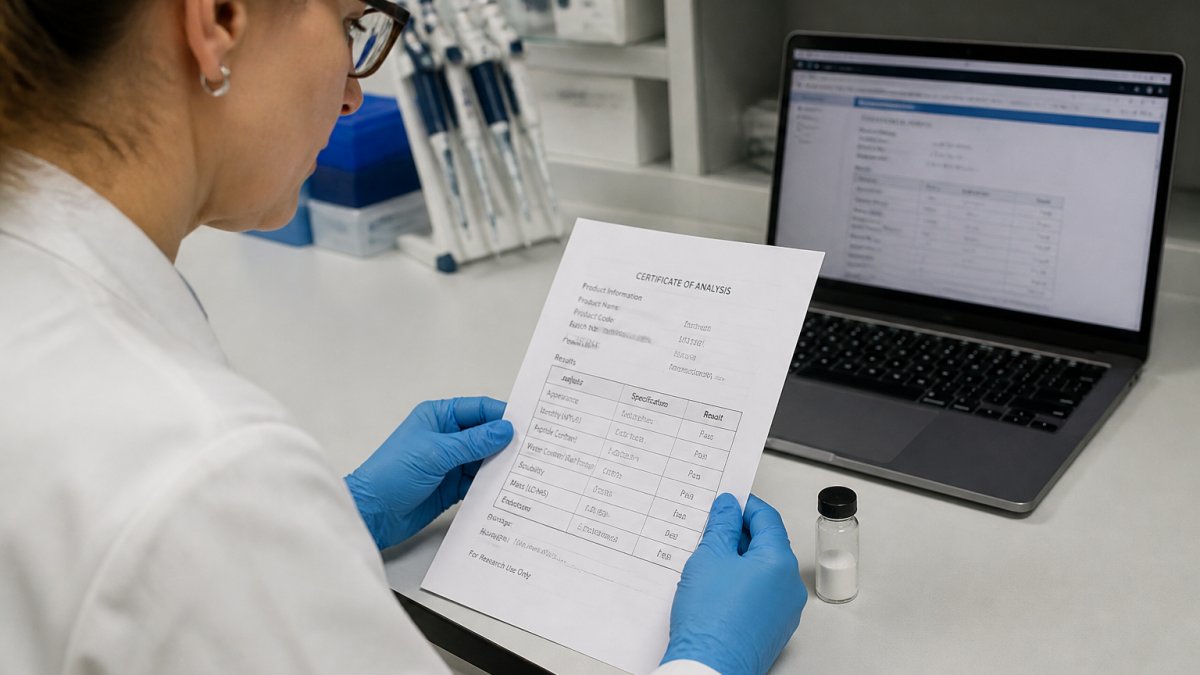
Batch-Specific vs Generic Documentation
The difference matters more than most buyers realise. Batch-specific documentation is traceable: it names the batch, the test date and the results for that material. Generic documentation is a template.
If you are comparing suppliers for analytical work, ask each one for the COA tied to the batch you would receive. A supplier who can produce it immediately is organised. One who cannot is a risk you do not need to take.
View the complete research peptide catalogue →
Your Peptide Order Checklist: What to Confirm Before You Pay
Use this peptide order checklist every time you buy, whether it is your first order or your fiftieth. It takes five minutes and prevents the most expensive mistakes.
- Batch-specific COA received and reviewed
- Catalogue number, nominal amount and stated strength confirmed
- Purity and identity results present on the COA
- Supplier has a UK address and company details
- Tracked dispatch and delivery timeline confirmed
- Payment method is traceable and secure
- Returns or replacement process understood
- Total cost in GBP confirmed, including any delivery charge
| Check | Why It Matters | What to Do If It Fails |
|---|---|---|
| Batch-specific COA | Ties results to your vial | Request it or walk away |
| Stated strength and amount | Prevents quantity errors | Confirm before paying |
| UK dispatch | Avoids customs delays | Ask for tracking details |
| Returns process | Covers documentation mismatch | Get it in writing |
How to Order Peptides Online: A Step-by-Step Process
The process is straightforward once verification is done. Here is how we would run it.
- Shortlist two or three suppliers that publish batch-specific documentation.
- Request the COA for the batch you would receive.
- Compare specifications across suppliers: purity, stated amount, catalogue reference.
- Confirm pricing in GBP and check delivery terms.
- Place your order through a secure checkout with a traceable payment method.
- Save your order confirmation and the COA together for your records.
When you order peptides from JGPep+, every product page states the vial contents and links to the batch-specific COA, so steps two and three take minutes rather than days.
What Happens After You Place Your Order
You should receive an order confirmation with tracking details. Tracked UK dispatch means you can follow the parcel and plan around its arrival.
Keep the COA with the order number. If you are running a regulated analytical method, that pairing is your traceability record.
What to Check When Your Peptide Order Arrives
Inspect the parcel before you store anything. Confirm the vial label matches your order: catalogue number, batch number and stated amount. Then check the batch number against the COA you received.
If anything does not match, contact the supplier before opening or using the material. A documented mismatch is grounds for a replacement, and raising it immediately keeps your records clean.
Store the material as your laboratory protocol requires, and file the COA with your batch records.
Common Mistakes When Ordering Research Peptides
Most problems trace back to the same handful of errors. The first is skipping verification because a supplier looks professional. Presentation is not documentation.
The second is accepting a generic COA. If it cannot be tied to your batch, it proves nothing about your material.
The third is prioritising price alone. A low price with no documentation is not a saving; it is an unquantified risk sitting in your freezer.
Frequently Asked Questions
How do I choose a reliable research peptide supplier?
Start by checking whether the supplier provides a batch-specific Certificate of Analysis for every product, not a generic document. Look for clear product identification, stated vial contents, and a UK-based dispatch address. Verify that the supplier states products are for research use only and not medicines. Read independent reviews, and ask for a sample COA before committing to a large order. A supplier that answers technical questions about purity, storage, and batch consistency is more likely to be reliable.
What should a peptide Certificate of Analysis include?
A proper peptide Certificate of Analysis should list the batch number, peptide name, molecular weight, and the analytical method used, such as HPLC or mass spectrometry. It should state the measured purity percentage for that specific batch, not a generic claim. Look for the date of analysis and the name of the testing facility. If you are ordering peptides online for analytical work, the COA must match the batch number on the vial you receive. A COA that lacks a batch number or method details is not useful for verification.
What questions should I ask before ordering peptides online?
Ask whether the supplier dispatches from within the UK and provides tracking. Confirm that a batch-specific COA is available before you order, not after. Ask about storage recommendations and whether the peptide is shipped lyophilised or in solution. Check the returns policy if the COA does not match the delivered batch. Ask about minimum order quantities and whether free delivery thresholds apply to smaller teaching-lab orders. A supplier that answers these clearly before you pay is easier to work with.
What should I check when a peptide order arrives?
Check that the batch number on each vial matches the batch number on the COA you received. Inspect the vial for damage, cracks, or a broken seal. Confirm the stated amount and strength match your order confirmation. If the peptide is lyophilised, check for a consistent powder appearance. Store it according to the supplier's instructions, usually at -20°C for long-term storage. If anything does not match, contact the supplier immediately and reference your order number and the COA discrepancy.
Ordering research peptides should feel as controlled as any other part of your laboratory workflow, and the difference is documentation. JGPep+ supplies research-grade peptides with clear product identification, batch-specific Certificates of Analysis, tracked dispatch and transparent GBP pricing, with free delivery on qualifying orders. If you are ready to compare materials with full documentation, view the complete research peptide catalogue and start your next order with confidence.