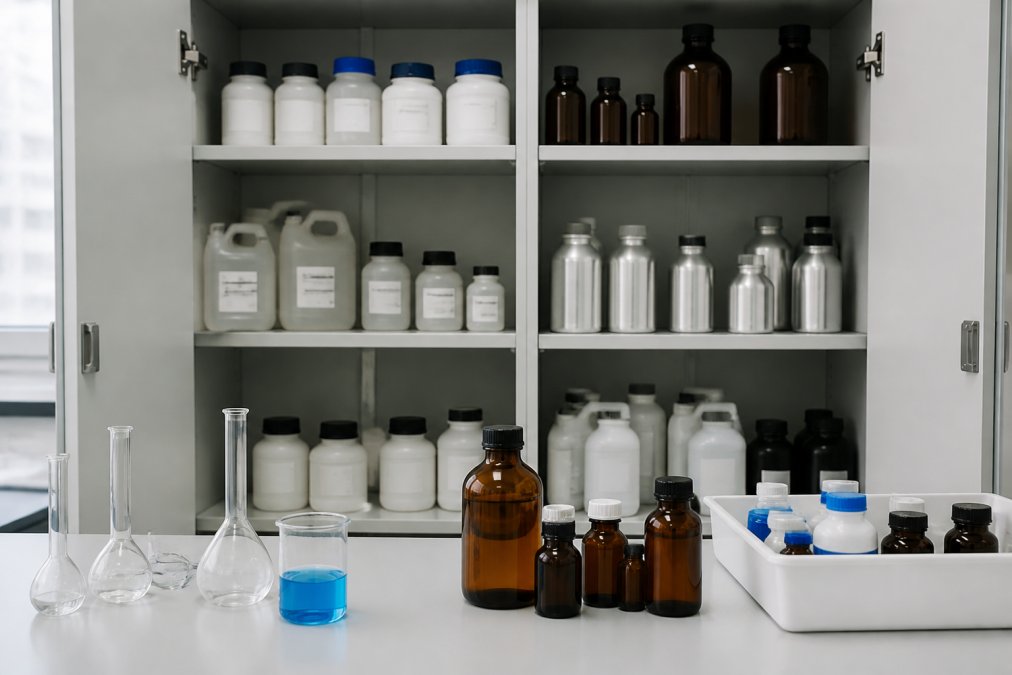
 blog
blog
5 Best Practices for Laboratory Chemical Storage
Table of Contents
- Why Laboratory Chemical Storage Matters More Than You Think
- Best Practice 1: Know Your COSHH Chemical Storage Regulations
- Best Practice 2: Segregate Chemicals Correctly Using a Laboratory Chemical Segregation Chart
- Best Practice 3: Label Every Container Clearly and Consistently
- Best Practice 4: Control Ventilation, Temperature and Humidity
- Best Practice 5: Run Regular Audits with a Laboratory Safety Audit Checklist
- Common Mistakes That Undermine Laboratory Chemical Storage
- Conclusion
- Frequently Asked Questions
Last Updated: September 14, 2026
Why Laboratory Chemical Storage Matters More Than You Think
Good laboratory chemical storage is the practice of keeping hazardous substances segregated, labelled, ventilated and auditable so that they stay stable and safe for the whole time they sit on your shelf. Get it wrong and you don't just risk a spill; you risk a failed experiment, an enforcement visit, or an injury. This guide from JGPep+ sets out the five practices that matter most in a working lab.
Here's the uncomfortable part. Most labs don't have a storage problem, they have a documentation problem. The chemicals are fine. The paperwork that proves they're fine is not.
A common mistake is treating the store cupboard as a passive space. In practice, it's an active system that degrades quietly: labels fade, lids corrode, incompatible bottles edge closer together, and nobody notices until an audit.
Below, we'll walk through the five practices that keep that system under control, and the mistakes that quietly undo all of them.
Best Practice 1: Know Your COSHH Chemical Storage Regulations
COSHH chemical storage regulations are the legal baseline for anyone holding hazardous substances in a workplace. In the UK, the Control of Substances Hazardous to Health Regulations 2002 require you to assess the risks, prevent or control exposure, and keep records that demonstrate you've done so (Control of Substances Hazardous to Health (COSHH)). The HSE guidance on COSHH is the place to start, not a forum thread.
What COSHH Requires for Chemical Storage
The regulation doesn't hand you a shelf plan. It sets outcomes: substances must be stored so they can't react with each other, escape containment, or harm anyone who handles them. That means assessing each substance, controlling access, and reviewing the assessment when anything changes.
Documents You Need to Keep on File
- Current COSHH assessments for every hazardous substance you hold
- Safety data sheets, dated and matched to the product in use
- A storage inventory with quantities and locations
- Training records for anyone who handles or moves stock
- Accident and near-miss logs
What most guides miss is that these documents are only as good as their last update. An assessment from three years ago that doesn't mention a substance you bought last month is worse than no assessment, because it looks like compliance.
Best Practice 2: Segregate Chemicals Correctly Using a Laboratory Chemical Segregation Chart
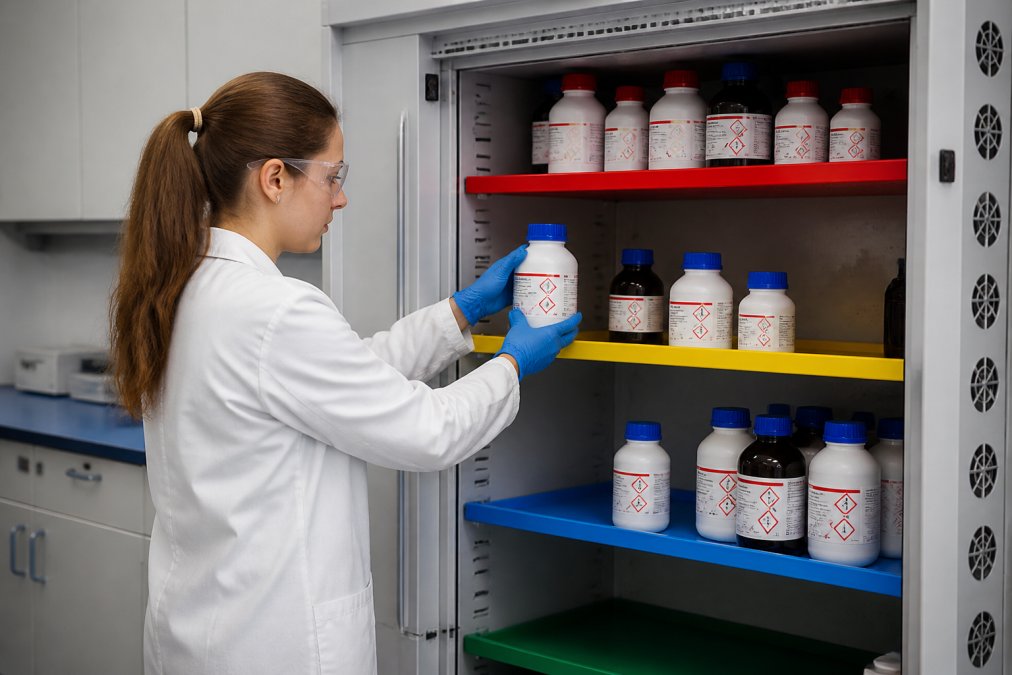
A laboratory chemical segregation chart is a reference that maps each hazard class to the classes it must never share a shelf with. The principle is simple: acids away from bases, oxidisers away from organics, water-reactive substances away from anything aqueous. The execution is where labs slip.
How to Read and Apply a Segregation Chart
Start with the hazard pictograms on the label, not the chemical name. Two substances with similar names can sit in different hazard classes. Cross-reference each pair before you place a bottle, and use secondary containment trays so a single failure stays contained.
Distance matters as much as separation. A chart that tells you to keep oxidisers and flammables apart assumes physical distance, not just a different shelf. If a spill from one can reach the other, they're not segregated.
Best Practice 3: Label Every Container Clearly and Consistently
Every container gets a label that states the substance name, hazard pictograms, concentration, date received, and date opened. No exceptions, including secondary containers and temporary decants. An unlabelled bottle is a hazard with no owner.
The practical rule: if you'd hesitate to hand a container to a colleague without explaining it, the label isn't good enough. Replace faded or smeared labels immediately rather than "when there's time." There never is.
View the complete research peptide catalogue →
Best Practice 4: Control Ventilation, Temperature and Humidity
Storage conditions determine how long a substance stays fit for use, so treat the store as a controlled environment. Ventilated cabinets for volatile or fume-producing substances, stable temperature away from direct sunlight, and humidity control for moisture-sensitive materials.
Check the manufacturer's stated storage conditions on the label and the safety data sheet. If a substance needs refrigeration, a warm shelf degrades it, and a degraded reagent produces unreliable results you'll blame on your method.
Best Practice 5: Run Regular Audits with a Laboratory Safety Audit Checklist
A laboratory safety audit checklist turns storage from a habit into a verifiable process. Audit monthly for high-turnover stores, quarterly for smaller ones, and always after a change of staff or supplier.
What to Include in Your Audit Checklist
- Every container labelled and legible
- Segregation verified against the current chart
- Expired or degraded stock removed and disposed of correctly
- Ventilation and temperature within range
- Inventory reconciled with physical stock
- COSHH assessments current for all substances held
Record the date, the findings, and who actioned them. An audit with no written output is just a walk around the room.
For labs that need to verify incoming materials, batch-specific documentation matters as much as the storage itself. JGPep+ supplies research materials with clear product identification, stated vial contents and a batch-specific Certificate of Analysis, which makes it straightforward to log a batch and trace it through storage. Our guidance on handling and documentation explains what arrives with each order.
Common Mistakes That Undermine Laboratory Chemical Storage
The failures that cause real problems are rarely dramatic. They're small, repeated, and invisible until something goes wrong.
| Mistake | Why it happens | The fix |
|---|---|---|
| Alphabetical shelving | Feels tidy and logical | Sort by hazard class, then alphabetically within class |
| Expired stock left in place | Nobody owns disposal | Assign a named person and a monthly disposal slot |
| Generic or missing labels | Decanting under time pressure | Pre-printed labels at every bench |
| Audit without records | Treated as a visual check | Written checklist with dated findings |
| Assessments never reviewed | No trigger to update them | Review on every new substance or supplier |
The pattern is the same in every case: the process exists on paper but not in the room. Fix the habit and the compliance follows.
Conclusion
The hard part of laboratory chemical storage isn't knowing the rules; it's keeping them alive when a deadline is close and a bottle needs somewhere to go. That's where documented, traceable supply makes a difference. JGPep+ provides batch-specific Certificates of Analysis, clear product identification and stated vial contents with every order, alongside tracked UK dispatch and free delivery on qualifying orders. View the complete research peptide catalogue and start your next project with materials you can actually verify.
Frequently Asked Questions
What are the COSHH requirements for chemical storage in a laboratory?
COSHH requires you to assess the risks from hazardous substances, store them safely, and prevent exposure to staff. For storage, this means keeping chemicals in suitable containers, segregating incompatible substances, ensuring adequate ventilation, and maintaining up-to-date safety data sheets and inventory records. You must also provide appropriate training and ensure containers are clearly labelled. The Health and Safety Executive (HSE) enforces these duties, and failure to comply can result in enforcement action, so regular reviews of your laboratory chemical storage arrangements are essential.
How should incompatible chemicals be segregated in a laboratory?
Use a laboratory chemical segregation chart to group substances by hazard class. Acids, bases, oxidisers, flammables and water-reactive chemicals should each have separate storage zones. Never store acids next to bases, or oxidisers near flammable solvents. Physical barriers such as separate cabinets or spill trays add a layer of protection. If space is limited, use secondary containment and distance to reduce risk. Review the chart whenever you introduce a new chemical to the lab, and update shelf labels so everyone can follow the same system.
How often should chemical inventories be audited for safety compliance?
Most laboratories should audit their chemical inventory at least every six months, with a quick visual check monthly. A laboratory safety audit checklist helps you track expiry dates, container condition, labelling accuracy and segregation compliance. High-turnover labs or those storing particularly hazardous substances may need quarterly audits. Record every audit, note any corrective actions, and assign responsibility for follow-up. Regular audits also help you identify duplicate purchases and dispose of unwanted chemicals before they become a storage problem.
What should a laboratory safety audit checklist include?
A laboratory safety audit checklist should cover container condition and labelling, correct segregation by hazard class, ventilation function, temperature and humidity readings, expiry dates, emergency equipment access, and staff training records. Include a section for spill kit availability and eyewash station checks. Each item should have a clear pass or fail mark and space for notes. After the audit, document any corrective actions with deadlines and responsible staff. This creates a traceable record that supports COSHH compliance and helps you spot trends before they become incidents.