 blog
What Is the Difference Between HPLC and MS Analysis?
Last Updated: 24 October 2026
Quick Summary
The difference between HPLC and MS analysis is one of purpose: HPLC separates a mixture into its individual components, while MS identifies what those components are by measuring their mass. HPLC and MS are therefore complementary techniques, and coupling them as LC-MS lets you separate and identify compounds in a single run.
- LC-MS runs in four stages: separation, ionisation, mass analysis and detection.
- An LC-MS method generally detects lower concentrations than a standalone HPLC method.
- Use HPLC for routine assays of known analytes that absorb UV well.
- Replace phosphate with volatile buffers such as formate or acetate when adding MS.
- MS costs more, demands cleaner samples and needs greater operator skill than HPLC.
Table of Contents
- The Core Difference Between HPLC and MS Analysis
- How LC-MS Works: Combining Separation With Detection
- HPLC vs Mass Spectrometry Sensitivity: Limits of Detection
- HPLC vs LC-MS Applications: Which Technique Fits Your Study
- HPLC Method Development: What Changes When MS Is Added
- Strengths and Limitations of Each Technique in Practice
- Selecting Research Materials for HPLC and MS Work
- Frequently Asked Questions
The Core Difference Between HPLC and MS Analysis
The difference between HPLC and MS analysis comes down to purpose: HPLC separates a mixture into its individual components, while MS identifies what those components are by measuring their mass. One is a separation technique. The other is a detection and identification technique. Confusing the two is a common mistake in method planning, and it can lead to instruments being specified for the wrong job.
HPLC (high-performance liquid chromatography) is a separation method. A liquid sample is pushed through a packed column under pressure. Components travel at different speeds depending on how they interact with the column packing and the mobile phase. They exit at different times, and a detector records those arrivals as peaks on a chromatogram.
Mass spectrometry is an analytical technique that ionises molecules and sorts the resulting ions by their mass-to-charge ratio. It tells you what a compound is, not just when it eluted.
So when researchers consider the difference between HPLC and MS analysis, the honest answer is that they solve different problems. HPLC answers "how many things are in here, and in what proportions?" MS answers "what is this thing?" Pair them and you can get both answers from one run.
How LC-MS Works: Combining Separation With Detection
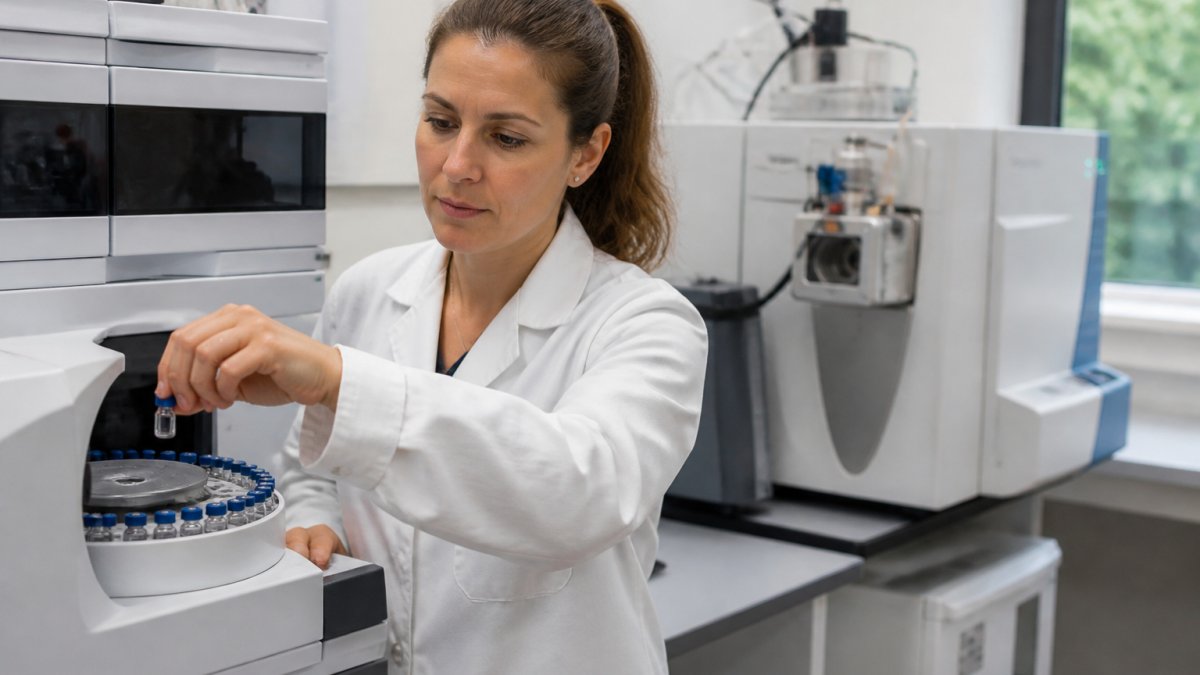
LC-MS works by coupling a liquid chromatograph directly to a mass spectrometer, so separated components flow straight from the column into the detector. The interface between the two is the hard part, and it is where most of the engineering lives.
The workflow runs in four stages:
- Separation. The HPLC column resolves the sample into components over time.
- Ionisation. An interface such as electrospray turns eluting molecules into charged ions, usually at atmospheric pressure.
- Mass analysis. The mass spectrometer separates ions by mass-to-charge ratio.
- Detection. A detector records the ion signal, producing a mass spectrum for each peak.
The payoff is confirmation. A peak on an HPLC trace tells you something eluted. The same peak on an LC-MS run tells you what it was. For readers who want the full principles and workflow, our guide to HPLC-MS/MS principles and method development goes deeper into instrument setup and tuning.
HPLC vs Mass Spectrometry Sensitivity: Limits of Detection
HPLC vs mass spectrometry sensitivity is not a fair fight, and it is not meant to be. An LC-MS method generally detects lower concentrations than a standalone HPLC method, because the mass spectrometer measures ions directly rather than relying on a bulk property such as UV absorbance.
In practice, sensitivity depends on the analyte, the ionisation efficiency and the sample matrix. Some compounds ionise poorly and give disappointing MS response. Others absorb strongly in UV and perform well on HPLC alone.
Practical points to weigh:
- Low-abundance analytes usually favour MS detection.
- Compounds with strong chromophores may need nothing more than a UV detector.
- Complex matrices often need the selectivity of MS to see the target at all.
- Running costs rise with MS, so sensitivity gains should justify the spend.
HPLC vs LC-MS Applications: Which Technique Fits Your Study
HPLC vs LC-MS applications split along a simple line: use HPLC when you need separation and quantification, and LC-MS when you also need identification or trace-level detection.
HPLC suits routine assays where the analytes are known and absorb UV well. Purity checks, content uniformity and teaching labs all run comfortably on HPLC alone. LC-MS suits confirmation work, impurity identification, metabolite studies and anything at low concentration in a messy matrix.
For peptide work specifically, HPLC remains the backbone of purity assessment. If you are interpreting those chromatograms, our guide to reading peptide HPLC analysis walks through peak shapes and what they signal.
View the complete research peptide catalogue →
| Question | HPLC alone | LC-MS |
|---|---|---|
| Is the analyte present and how much? | Yes | Yes |
| What is the analyte? | No | Yes |
| Trace-level detection | Limited | Strong |
| Structural information | None | Yes |
| Routine running cost | Lower | Higher |
HPLC Method Development: What Changes When MS Is Added
HPLC method development changes when MS enters the picture, mainly because the mobile phase must now be friendly to the ion source. Buffers that suit UV detection can suppress ionisation or foul the interface.
What shifts:
- Volatile buffers. Replace phosphate with formate or acetate so the mobile phase evaporates cleanly.
- Flow rate. Lower flow often suits the interface better, so run times may stretch.
- Solvent choice. Keep organic content within the range the ion source tolerates.
- Gradient design. Sharper gradients can overload the detector; smooth them out.
A common mistake is developing the HPLC method first and bolting MS on afterwards. Build both into the plan from day one and you avoid a rebuild later.
Strengths and Limitations of Each Technique in Practice
HPLC is cheap to run, rugged and forgiving. It is also blind to anything without a suitable chromophore, and it cannot tell you what a peak actually is. Those limits matter when a purity figure needs defending.
MS gives identification and low-level detection, but it costs more, demands cleaner samples and needs more operator skill. Ion suppression can distort results if not checked for.
Where detection limits and verification are the priority, our lab guide to verifying peptide purity covers the checks that back up a purity claim.
Selecting Research Materials for HPLC and MS Work
Materials choice decides whether a method behaves. For HPLC and MS work, the practical requirements are consistent grade, documented purity and a paper trail you can audit.
At JGPep+, every product carries clear identification, stated vial contents and a batch-specific Certificate of Analysis, so you can check batch records before a run rather than after. If you are new to those documents, our guide to interpreting peptide COA data explains what each section means.
Our laboratory solutions range covers the solvents and consumables that support this work. Pricing is shown in GBP on the site, and tracked dispatch keeps timelines predictable.
Frequently Asked Questions
What is the difference between HPLC and mass spectrometry?
HPLC separates the components of a mixture in a liquid stream and detects them, usually by UV absorbance. Mass spectrometry ionises molecules and measures their mass-to-charge ratio, giving structural and molecular weight information. HPLC tells you how many components elute and when; MS tells you what those components are. Used together as LC-MS, they deliver both separation and identification in a single run.
Is HPLC the same as LC-MS?
No. HPLC is the liquid chromatography separation step on its own, typically paired with a UV or fluorescence detector. LC-MS is HPLC coupled to a mass spectrometer, so the eluent from the column feeds directly into the MS. Every LC-MS system contains an HPLC component, but an HPLC system without an MS detector cannot confirm molecular identity. The two are related but not interchangeable.
Which is more sensitive, HPLC or MS?
Mass spectrometry generally achieves lower limits of detection than UV-based HPLC, often reaching trace levels where HPLC-UV would miss a compound entirely. Sensitivity depends on the analyte, ionisation efficiency and instrument mode, so exact figures vary by method. For impurity profiling or low-abundance peptides, LC-MS is usually the preferred choice, while HPLC-UV remains adequate for main-component assays.
When should you use HPLC-MS instead of HPLC alone?
Choose LC-MS when you need to confirm compound identity, detect trace impurities, or analyse mixtures where peaks co-elute under UV detection. HPLC alone suits routine purity assays, quantitative work with a known standard, and teaching labs where cost and simplicity matter. If your research question involves molecular weight confirmation or structural elucidation, the added MS dimension is worth the extra cost and method development time.
Getting a method right the first time saves weeks of rework, and that starts with materials you can verify. JGPep+ supplies research peptides with clear product identification, batch-specific COA documentation and tracked UK dispatch, with free delivery on qualifying orders. Browse the complete research peptide catalogue and match your specification to a documented batch before your next run.