 blog
blog
Who Sells the Purest Peptides? A 2026 Buyer's Guide
Table of Contents
- What Purity Actually Means for Research Peptides
- The Questions That Decide Who Sells the Purest Peptides
- How to Read a Peptide COA Before You Order
- Best Peptideslab Alternatives for UK Laboratory Buyers
- Red Flags That Signal Impure or Undocumented Peptides
- Why Batch Consistency Matters More Than a Single Purity Claim
- Frequently Asked Questions
Last Updated: September 11, 2026
What Purity Actually Means for Research Peptides
Purity in research peptides refers to the proportion of the target peptide present in a vial relative to synthesis by-products, truncated sequences and residual solvents. A supplier claiming 98% purity means 98% of the analysed material is the intended sequence.
That figure comes from a single test, on a single batch, at a single point in time. This guide from JGPep+ breaks down what separates suppliers who can prove purity from those who simply assert it, so you can decide who sells the purest peptides for your work.
Most buyers ask the wrong question first. They want a headline number. The better question is whether that number is traceable to the vial in your hand.
Chromatographic purity is not the same as net peptide content. A vial can be 98% pure by high-performance liquid chromatography (HPLC) and still contain only 70% actual peptide by mass, with the remainder being counter-ions, water and salts. The United States Pharmacopeia general chapter on peptide analysis sets out how these measurements differ, and the distinction matters when you calculate molar concentrations for an assay.
Below, we cover the four questions that decide who sells the purest peptides, how to read a certificate of analysis (COA) properly, and the red flags that should end a supplier conversation before you order.
The Questions That Decide Who Sells the Purest Peptides
Four questions separate documented suppliers from undocumented ones. Ask all four before placing an order, and you will filter most of the market in a single email.
The answers tell you whether a supplier understands peptide chemistry or is reselling vials with a copied document. Here is what to look for.
Is the COA batch-specific or generic?
A batch-specific COA carries a lot number that matches the vial label, plus test dates and instrument data unique to that production run. A generic COA is a template with no lot reference, often recycled across every product a supplier sells.
Ask for the COA for the exact lot you will receive, not a sample document. If a supplier cannot produce a lot-matched certificate before dispatch, the purity claim is unverifiable.
Does the supplier state net peptide content?
Net peptide content is the mass of actual peptide in the vial, expressed as a percentage of total vial contents. It accounts for counter-ions such as trifluoroacetate and acetate, plus residual water.
Without this figure, you cannot calculate accurate molar concentrations. A vial labelled 5 mg may contain closer to 3.5 mg of peptide. For quantitative analytical work, that discrepancy invalidates your results.
How to Read a Peptide COA Before You Order
Reading a peptide COA means checking four things: the lot number against your vial, the analytical methods used, the reported values, and the date of testing. A certificate missing any of these is incomplete.
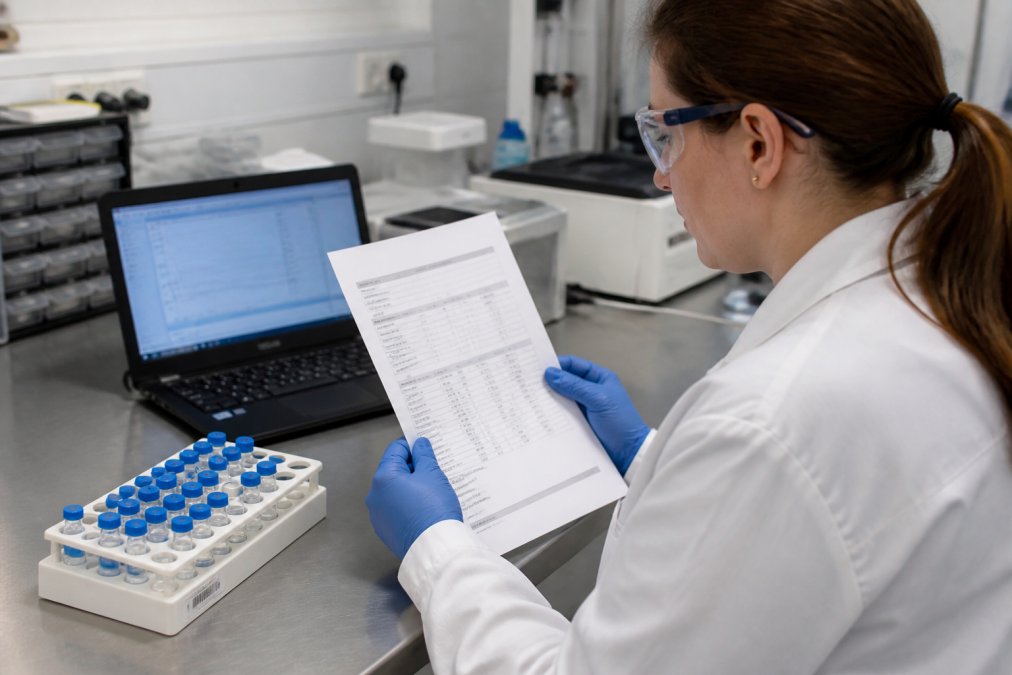
Start with the header. The lot number, product name, sequence and molecular weight should all be present and consistent with the product listing. Then move to the analytical data.
HPLC: what the trace tells you
HPLC separates the components in a sample and reports each as a peak. The main peak represents your target peptide; smaller peaks are impurities, truncations or deletion sequences.
Look for the retention time, the column and mobile phase conditions, and the wavelength used for detection. A purity figure without the chromatogram attached is an assertion, not evidence. The Royal Society of Chemistry guidance on chromatographic methods explains why method conditions must be reported for a result to be reproducible.
Mass spectrometry: confirming identity
Mass spectrometry confirms that the molecule in the vial is the sequence you ordered. It reports the molecular mass, which should match the theoretical mass of your peptide within a narrow tolerance.
Purity and identity are separate checks. A sample can be 99% pure and still be the wrong peptide entirely. Both results belong on a complete COA.
Best Peptideslab Alternatives for UK Laboratory Buyers
Buyers searching for the best peptideslab alternatives are usually looking for three things: batch-specific documentation, UK-based dispatch, and clear pricing in pounds. Those three factors matter more than any headline purity figure.
| What to Check | Weak Supplier | Strong Supplier |
|---|---|---|
| COA scope | Generic template | Lot-matched, dated |
| Net peptide content | Not stated | Stated per batch |
| Analytical data | Purity figure only | HPLC trace plus mass spec |
| Dispatch | Overseas, customs risk | Tracked domestic dispatch |
| Pricing | Unclear until invoice | Published, transparent |
JGPep+ supplies research peptides and laboratory materials for in vitro, analytical and non-clinical work only. Every product carries clear identification, stated vial contents and a batch-specific COA, with tracked UK dispatch and free delivery on qualifying orders. Products are not medicines and are not intended for human or veterinary use.
Red Flags That Signal Impure or Undocumented Peptides
Certain patterns predict problems before you ever run an assay. Watch for a purity claim with no supporting chromatogram, a COA that lacks a lot number, or a supplier who cannot state net peptide content.
Other warnings: prices far below the market norm with no explanation, product pages that list vague names instead of sequences and catalogue references, and certificates dated years before the batch you receive. Any one of these justifies walking away.
A common mistake is treating a single purity percentage as the whole story. In practice, the documentation trail matters more than the number printed at the top of it.
Why Batch Consistency Matters More Than a Single Purity Claim
Batch-to-batch consistency determines whether your results are reproducible. A supplier who delivers 98% purity once and 85% the next time is worse than one who reliably delivers 95% every time.
For longitudinal studies, method development and teaching labs, variability is the enemy. Ask suppliers how they handle retesting and whether they retain reference samples from each lot. The Medicines and Healthcare products Regulatory Agency guidance on laboratory standards provides useful context on documentation expectations for analytical work.
Frequently Asked Questions
How can I verify the purity of peptides before I buy?
Ask for the batch-specific Certificate of Analysis and check that the batch number on the document matches the vial you receive. The COA should show an HPLC purity figure, a mass spectrometry result confirming molecular identity, and the test date. A supplier selling the purest peptides will publish this per batch rather than sending a generic document. If the COA cannot be tied to your specific batch, the purity claim is unverifiable.
What is a Certificate of Analysis (COA) for peptides?
A COA is the analytical record for one production batch. It typically lists the peptide name, catalogue reference, batch number, stated strength, HPLC purity percentage, mass spectrometry data, appearance, and storage guidance. For research buyers, the key detail is that it is batch-specific: two vials from different batches should carry different COAs. Learning how to read a peptide COA is the single most useful skill for comparing suppliers on evidence rather than marketing claims.
Are research-grade peptides suitable for human use?
No. Research-grade peptides supplied for in vitro and analytical work are not medicines and are not intended for human or veterinary use. They are not manufactured under medicines regulations and carry no clinical safety or dosing data. Laboratory suppliers state this clearly, and buyers should treat any supplier that blurs the distinction as a warning sign. If you need a substance for clinical purposes, that is a different regulatory category entirely.
What standards should a reputable peptide supplier meet?
A supplier worth using provides batch-specific COAs, states net peptide content rather than just vial weight, lists clear catalogue references, and dispatches with tracking. Pricing should be transparent in GBP so you can compare like for like. Batch-to-batch consistency matters too: ask whether purity is verified on every lot or only on a reference sample. Suppliers that answer these questions directly, and back them with documents, are the ones worth shortlisting for your research.
Choosing a supplier comes down to documentation you can verify, not claims you have to trust. JGPep+ provides batch-specific COAs, stated vial contents and transparent GBP pricing, with tracked UK dispatch and free delivery on orders over £100. Every product is supplied strictly for lawful in vitro and analytical research. View the complete research peptide catalogue to compare specifications and request the batch documentation you need.