 how-to
Managing Batch Consistency in Peptide Experiments: A Lab Guide
Table of Contents
- Why Batch Consistency Makes or Breaks Peptide Experiments
- Prerequisites: What You Need Before You Start
- Step 1: Verify Batch Identity and Purity Through Certificate of Analysis Interpretation
- Step 2: Apply Peptide Storage Best Practices to Protect Batch Integrity
- Step 3: Follow Peptide Reconstitution Protocols That Reduce Variability
- Step 4: Track Inventory and Document Batch History
- Common Mistakes That Undermine Batch Consistency in Peptide Experiments
- Troubleshooting: When Results Diverge Between Batches
- Frequently Asked Questions
Last Updated: 16 September 2026
Why Batch Consistency Makes or Breaks Peptide Experiments
Batch consistency is the degree to which separate production lots of the same peptide match each other in identity, purity, and measured mass. When it slips, results you have already published become hard to defend. This guide from JGPep+ covers how to verify, store, reconstitute, and document research peptides so that one lot behaves like the next.
The problem is rarely a dramatic failure. A vial that arrives at 85% purity instead of 99% will still dissolve, still run on the instrument, and still produce a curve. It will simply produce a different curve from last month's, and the difference will look like biology rather than a supply issue.
That is why managing batch consistency in peptide experiments is less about any single technique and more about building a chain of evidence: a batch-specific Certificate of Analysis at the point of order, controlled storage between uses, a reconstitution method you repeat exactly, and a record that lets you trace an anomaly back to a lot number. The four steps below cover each link in that chain, plus the mistakes that break it.
Prerequisites: What You Need Before You Start
You need four things in place before the first vial is opened: batch-specific documentation, calibrated equipment, a documented storage location, and a log that links every aliquot to its lot number.
The documentation matters most. A Certificate of Analysis is only useful if it refers to the specific lot in your hand rather than a generic specification sheet. Confirm that before anything else.
Your bench should also have:
- A calibrated analytical balance readable to 0.1 mg or finer
- A pH meter with fresh calibration buffers
- A pipette set within its calibration window
- A desiccator or dry storage cabinet
- A freezer with a logged temperature record
Step 1: Verify Batch Identity and Purity Through Certificate of Analysis Interpretation
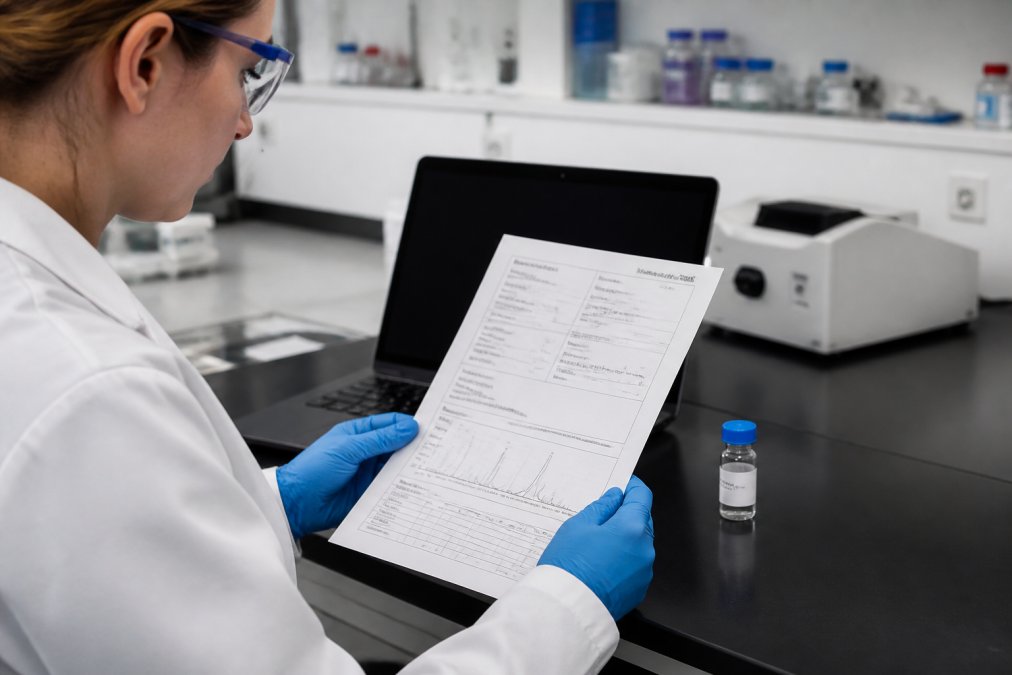
Certificate of Analysis interpretation means matching three data sets on the document against the physical vial: lot number, stated purity, and observed molecular mass. If any one of them disagrees, quarantine the vial before use.
Start with the lot number on the label and the lot number on the certificate. They must be identical, character for character. A supplier that issues one certificate covering a product line rather than a specific lot is telling you nothing about what is in the vial.
Reading HPLC and Mass Spectrometry Data
High-performance liquid chromatography reports purity as the area percentage of the principal peak. Read the method as well as the number: column type, gradient, wavelength, and run time all affect the result, and a purity figure quoted without a method is difficult to interpret.
Mass spectrometry confirms identity rather than purity. Compare the observed mass against the theoretical mass for the peptide sequence, and check whether the reported value refers to the free base or a salt form. A mismatch here usually points to a counter-ion or hydration difference rather than a synthesis error, but it must be resolved before the material goes into an assay.
Step 2: Apply Peptide Storage Best Practices to Protect Batch Integrity
Peptide storage best practices come down to three controls: low temperature, exclusion of light, and active desiccation. Get these right and most batches will hold their specification for the full working life of the project.
Lyophilised powder is the more stable form and should be kept frozen until you are ready to reconstitute. Once in solution, stability falls sharply, and the clock starts the moment the solvent touches the powder.
Temperature, Light and Desiccation Controls
Store lyophilised material at -20°C for routine work and -80°C where the peptide is known to be labile or the study runs over many months. Avoid frost-free freezers for long-term storage; the automatic defrost cycle introduces repeated temperature excursions that are invisible on a daily check.
Keep vials in amber glass or wrap them in foil. Many residues, particularly those containing tryptophan, tyrosine, or cysteine, are sensitive to ambient light.
Moisture is the control most often neglected. Let a frozen vial reach room temperature in a sealed container before opening it, so condensation forms on the outside rather than inside. A desiccator with fresh silica gel handles the rest.
Step 3: Follow Peptide Reconstitution Protocols That Reduce Variability
Peptide reconstitution protocols reduce variability by fixing three variables: solvent, concentration, and technique. Change any one of them between batches and you have introduced a difference that has nothing to do with the peptide.
View the complete research peptide catalogue →
The solvent choice depends on the peptide. Many dissolve readily in water; hydrophobic sequences often need a small amount of acetonitrile or dimethyl sulfoxide first, then dilution. Use the same solvent system for every batch in a series.
Solvent Selection and Concentration Calculations
Calculate concentration from the net peptide content stated on the certificate, not from the gross vial weight. If the certificate reports a purity of 95% and a net content figure, that is the number to use. Reconstituting on gross weight is one of the most common sources of a systematic offset between batches.
Work through the calculation once and record it:
- Note the net peptide mass stated on the COA
- Divide by the target molar concentration and the molecular weight
- Add the calculated solvent volume in one go, not in increments
- Mix gently by inversion; avoid vortexing, which foams and can denature
- Record the final concentration and the date in your log
Prepare single-use aliquots immediately after reconstitution and freeze them at -20°C or below. Repeated freeze-thaw cycles degrade the material and add an uncontrolled variable to every downstream result.
Step 4: Track Inventory and Document Batch History
Inventory tracking is what turns a set of good habits into a defensible record. Every vial should be traceable from purchase order to experiment, with the lot number as the linking key.
A simple system is enough. Assign each incoming lot an internal reference, file the batch-specific certificate against it, and record the storage location and receipt date. When an aliquot leaves the freezer, log the date, the operator, and the experiment it was used in.
| Record | What to capture | Where it lives |
|---|---|---|
| Receipt | Lot number, date, quantity, COA reference | Goods-in log |
| Storage | Freezer ID, shelf, temperature setpoint | Inventory sheet |
| Reconstitution | Solvent, volume, final concentration, date | Preparation log |
| Use | Experiment ID, operator, aliquot ID | Bench notebook |
| Disposal | Date, remaining volume, reason | Inventory sheet |
What most guides miss is that the record only has value if it is written at the time. A log reconstructed from memory after a failed run is not evidence, it is a guess.
Common Mistakes That Undermine Batch Consistency in Peptide Experiments
The mistakes that undermine batch consistency are almost never technical. They are procedural, and they repeat across laboratories.
- Using one certificate for multiple lots. A generic document cannot tell you what is in a specific vial.
- Reconstituting on gross weight. This produces a concentration offset that scales with purity.
- Thawing and refreezing. Each cycle adds degradation that accumulates silently.
- Switching solvent systems mid-study. Results diverge for reasons that have nothing to do with the peptide.
- Storing in a frost-free freezer. The defrost cycle creates temperature swings that a daily reading will not catch.
Troubleshooting: When Results Diverge Between Batches
When results diverge, work backwards through the chain before assuming the peptide has changed. In most cases the material is fine and something in handling, storage, or calculation has shifted.
Start with the certificates. Compare the purity method, the net content figure, and the counter-ion form across the two lots. A change in counter-ion alone can shift a mass-based concentration by a meaningful margin.
Then check the handling record.
Frequently Asked Questions
Why is batch consistency critical for peptide research reproducibility?
Batch consistency directly affects whether your results can be replicated. If one batch is 99% pure and the next is 85%, any shift in experimental outcomes could reflect the material rather than your variables. Reproducibility depends on using peptide batches with documented, stable purity and composition. Without batch consistency, you cannot confidently attribute changes to your experimental conditions, which undermines publication and method validation.
How do I interpret a Certificate of Analysis (COA) for peptide batches?
Start by checking the batch number, sequence, and molecular weight against your order. Then review the HPLC trace for purity percentage and the mass spectrometry data for identity confirmation. Look for a clear method description and acceptance criteria. A batch-specific COA should show actual results for that lot, not a generic specification sheet. If any value falls outside your required range, request a replacement or further documentation before use.
What factors contribute to batch-to-batch variability in synthetic peptides?
Variability can arise from synthesis efficiency, purification steps, and handling after production. Coupling failures during synthesis may leave truncated sequences. Purification gradients might not remove all impurities. Post-synthesis factors like exposure to moisture, heat, or repeated freeze-thaw cycles also alter peptide integrity. Using a supplier that provides batch-specific COA documentation helps you identify and exclude batches that fall outside your specifications.
How should peptides be stored to maintain consistency between experiments?
Store lyophilised peptides at -20°C or lower, protected from light and moisture. Once reconstituted, aliquot into single-use volumes and keep at -80°C for long-term storage. Avoid repeated freeze-thaw cycles, which degrade peptides and introduce variability. Use desiccants in storage containers and allow vials to reach room temperature before opening to prevent condensation. Consistent storage conditions across batches are as important as the initial purity.