 how-to
How to Verify Peptide Purity: A Lab Guide
Table of Contents
- What You'll Need Before You Start Verifying Purity
- How to Read a Peptide COA
- Peptide Certificate of Analysis Interpretation: Matching Document to Vial
- HPLC vs Mass Spectrometry for Peptides: What Each Method Proves
- How to Verify Peptide Purity in Your Own Laboratory
- Common Mistakes and Troubleshooting When Verifying Peptide Purity
- Frequently Asked Questions
Last Updated: September 17, 2026
What You'll Need Before You Start Verifying Purity
Learning how to verify peptide purity starts with understanding what you're actually checking. You are not confirming a single number. You are testing whether a document matches a physical vial, and whether both match what you were told you bought.
At JGPep+, every product ships with a batch-specific Certificate of Analysis (COA) so researchers can check records against the vial in their hand. That documentation is the foundation of verification.
Before you begin, gather these items:
- The vial itself, with its batch or lot number visible
- The COA that came with that batch
- Access to the supplier's published documentation
- A notebook to record what you find
- Your lab's standard operating procedures
You do not need a full analytical suite to do a documentation check. You need patience and a sceptical eye.
How to Read a Peptide COA
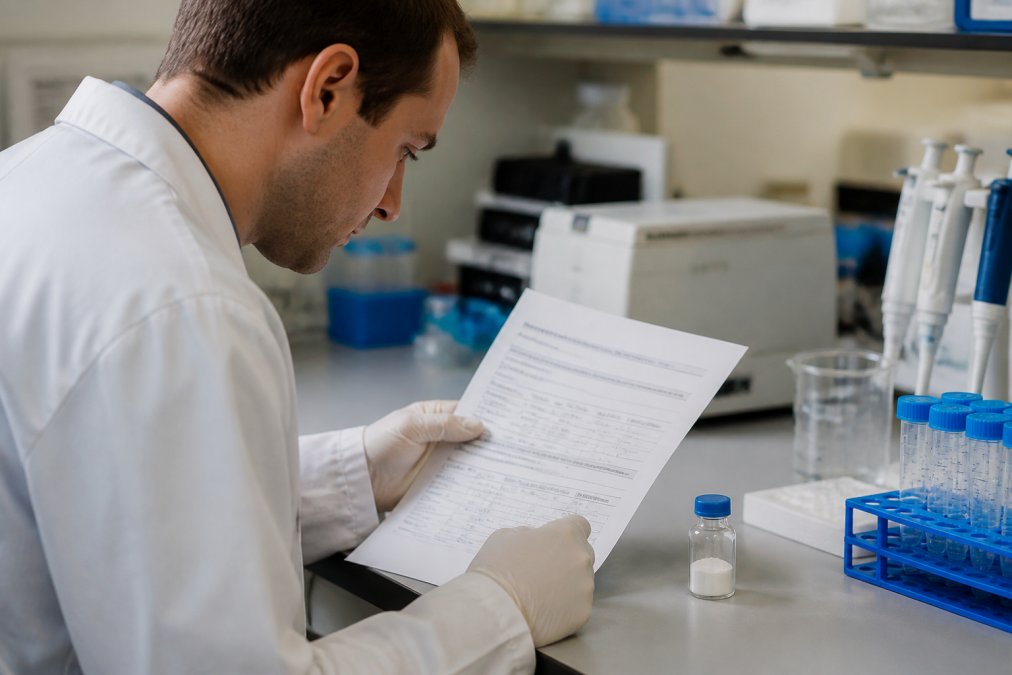
A peptide Certificate of Analysis is a document that states what a specific batch contains and how it was tested. It should list the peptide name, batch number, purity result, and the method used to obtain that result.
To read a peptide COA properly, work through it in order. Start with the identity fields, then move to the test results, then check the dates and signatures.
The Fields That Actually Matter
Most COAs look impressive. Few contain everything you need. These are the fields worth your attention:
- Batch or lot number - must match your vial exactly
- Peptide name and sequence - should match the product you ordered
- Purity figure - usually given as a percentage from chromatographic analysis
- Test method - states whether HPLC, mass spectrometry, or both were used
- Molecular mass - the expected weight of the peptide
- Test date - when the analysis was run
- Analyst or lab signature - who performed and approved the work
If any of these are missing, treat the document as incomplete.
Spotting a Generic or Recycled Document
A common trick is a COA that looks real but applies to nothing in particular. Watch for these warning signs:
- The batch number on the COA does not match your vial
- The document uses a generic product name with no sequence
- Test dates are years old or identical across different products
- Purity is stated with no method behind it
- The layout matches other suppliers' documents word for word
A real certificate is tied to one batch. If it could describe any vial, it describes none.
Peptide Certificate of Analysis Interpretation: Matching Document to Vial
Interpretation is where most people stop too early. They read the purity figure, nod, and move on. The real work is confirming the document belongs to the vial in front of you.
Run through this checklist every time:
- Vial label batch number matches the COA batch number
- Peptide name and sequence match your order
- Purity figure is stated alongside its test method
- Molecular mass on the COA matches the expected mass for that sequence
- Test date is recent enough for your purposes
- Document carries a lab or analyst identifier
If every box is ticked, you have a document that at least corresponds to your material. That is a starting point, not a finish line.
What most guides miss is that matching numbers prove nothing about accuracy. They prove consistency between two pieces of paper and a label. Only testing proves what is actually in the vial.
HPLC vs Mass Spectrometry for Peptides: What Each Method Proves
HPLC and mass spectrometry answer different questions, and a strong COA uses both.
High-performance liquid chromatography (HPLC) separates the components of a sample and measures how much of each is present. For peptides, it produces a purity figure, usually expressed as a percentage of the main peak.
Mass spectrometry (MS) measures molecular mass. It confirms that the dominant molecule in the sample has the weight expected for your peptide sequence.
View the complete research peptide catalogue →
Put simply: HPLC tells you how much of the sample is one thing. MS tells you whether that one thing is the right thing.
When to Use Each Method
Use HPLC when you need a purity figure for a batch. Use mass spectrometry when you need to confirm identity.
| Method | What It Proves | What It Cannot Prove |
|---|---|---|
| HPLC | Relative purity of the main peak | That the peak is your peptide |
| Mass spectrometry | Molecular mass matches the sequence | Overall purity of the sample |
| HPLC plus MS | Purity and identity together | Sterility or endotoxin status |
A COA showing only one method leaves a gap. A COA showing both closes most of it.
How to Verify Peptide Purity in Your Own Laboratory
In-house verification means running your own analysis rather than trusting the supplier's document. This is the only way to confirm what is actually in the vial.
The standard approach is reverse-phase HPLC with UV detection, paired with mass spectrometry for identity. Many labs also run a simple visual check first: dissolve a small sample and look for clarity, colour, and any undissolved material.
Steps for a basic in-house check:
- Confirm your HPLC system is calibrated and the column is suited to peptides
- Prepare a sample at a known concentration using your standard solvent
- Run a blank and a reference standard before your sample
- Record the retention time and peak area of the main peak
- Compare the purity figure with the COA
- Run mass spectrometry to confirm molecular mass
- Document everything in your lab notebook
If your results diverge from the COA, re-run before drawing conclusions. A single odd result is usually a preparation issue, not a product issue. For guidance on analytical method development, resources from the Royal Society of Chemistry are a useful starting point.
Common Mistakes and Troubleshooting When Verifying Peptide Purity
The biggest mistake is treating the COA as proof rather than as a claim to be checked. A document is only as good as the batch it describes.
Other frequent errors:
- Reading only the purity figure. A high number means little without the method and the identity check behind it.
- Ignoring batch-to-batch variation. Two batches from the same supplier can differ. Always check the COA that matches your vial.
- Skipping the retention time comparison. If your peak elutes far from where the reference does, something is wrong, even if the purity looks fine.
- Testing too late. Run your check when the batch arrives, not months into a project.
- Assuming a missing field is a minor issue. Missing data is a red flag, not a formatting quirk.
For general laboratory quality principles, the UK Accreditation Service publishes guidance that applies to analytical testing environments.
Verifying peptide purity is a documentation discipline first and a laboratory exercise second. The gap between a claim and a confirmed result is where research timelines break, and closing that gap is the whole job.
JGPep+ supports that work with clear product identification, stated vial contents, and a batch-specific Certificate of Analysis for every product. Our catalogue is built for lawful in vitro and analytical research, with transparent GBP pricing, tracked UK dispatch, and free delivery on qualifying orders over £100.
Get started with JGPep+ and give your lab documentation it can actually check. View the complete research peptide catalogue to compare batch records and purity records before your next order.
Frequently Asked Questions
What is a Certificate of Analysis (COA) for peptides?
A COA is a batch-specific document that records the results of analytical testing carried out on a particular production lot. For peptides it typically states the batch number, the stated strength or nominal amount, the purity figure, and the analytical methods used, such as HPLC and mass spectrometry. It should also list storage conditions and any observed impurities. A genuine COA ties to one specific batch, not to a product line in general.
How do HPLC and mass spectrometry verify peptide purity?
HPLC separates the components of a sample by how they travel through a column, so the main peak's area as a percentage of total peak area gives a purity estimate. Mass spectrometry measures the molecular mass of the peptide, confirming the sequence is what the label claims. Used together, HPLC tells you how much of the sample is your target peptide, and mass spectrometry confirms the identity of that peptide. Neither method alone gives the full picture.
What are the common impurities found in synthetic peptides?
Synthetic peptides commonly carry deletion sequences, truncated fragments, and oxidation or deamidation products formed during synthesis or storage. Residual solvents and counterions from the purification step can also appear. These impurities matter because they can shift assay results in in vitro work.
How can researchers identify a reputable peptide supplier?
Look for a supplier that provides a batch-specific COA for every product, states vial contents and nominal amounts clearly, and publishes catalogue references you can cross-check. Ask whether the COA is available before you order, not afterwards. A supplier that answers documentation questions directly and supplies UK dispatch with tracking is easier to audit than one that sends generic paperwork or ships from overseas with customs delays.