 how-to
How to Interpret Peptide COA Data: A 2026 Guide
Table of Contents
- Why Peptide COA Data Matters for Your Research
- Key Sections of a Peptide COA Explained
- HPLC vs Mass Spectrometry Peptide Analysis
- Understanding Net Peptide Content
- Your Peptide COA Validation Checklist
- Common Red Flags and Mistakes to Avoid
- Conclusion
- Frequently Asked Questions
Last Updated: October 1, 2026
Why Peptide COA Data Matters for Your Research
Learning how to interpret peptide COA data is the single most useful skill you can build before placing a research order. A Certificate of Analysis is the batch-specific record of what was tested, how it was tested, and what the results were. Without it, you are guessing. This guide from JGPep+ walks through every section of a peptide COA so you can read one with confidence.
Here is the part most guides skip: a COA is not a marketing document. It is a technical record, and it only means something if you check it against the vial in your hand. Batch numbers must match. Test methods must be named. Results must carry units.
Below, we break down each section, explain the difference between HPLC and mass spectrometry results, and give you a checklist you can use the moment a delivery arrives. The goal is simple: you should be able to look at any COA and decide, in minutes, whether that batch is fit for your work.
Key Sections of a Peptide COA Explained
Every peptide COA follows a similar shape, though layouts differ between suppliers. A complete document identifies the batch, describes the product, states purity and quantity, explains how the material was tested, and gives storage guidance. If any of those pieces are missing, treat the document as incomplete.
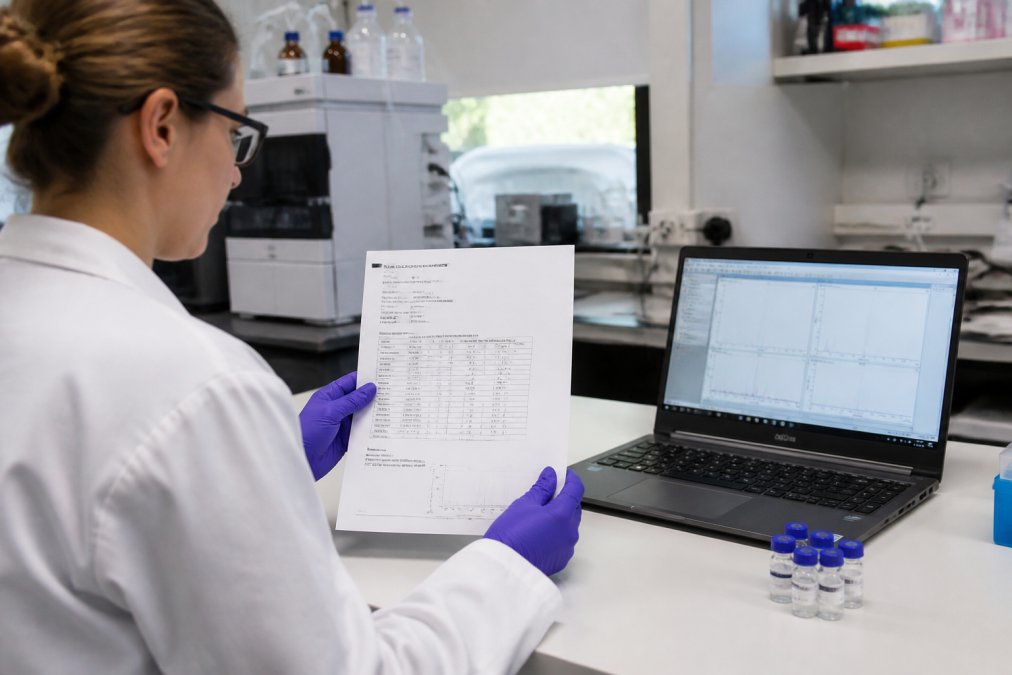
Batch Identification and Product Details
The top block is your traceability anchor. It should list the catalogue reference, the batch or lot number, the peptide sequence, the molecular formula, and the nominal amount in the vial.
Check these details line by line:
- Catalogue reference must match your order confirmation
- Batch number must match the label on the vial itself
- Sequence and formula must match the peptide you intended to study
- Nominal amount states what the vial is sold as containing
A common mistake is accepting a generic COA that lists no batch number. That document cannot be tied to your vial, so it proves nothing about the material in front of you.
Purity, Quantity, and Storage Information
Purity is normally reported as a percentage from chromatographic analysis. Quantity may be given as net peptide content rather than gross vial weight. Storage guidance tells you the recommended temperature and how to handle the vial once opened.
Read these three together, not separately. A purity figure without a stated method is weak evidence. A quantity figure without a net content basis can mislead you about how much actual peptide you have.
HPLC vs Mass Spectrometry Peptide Analysis
HPLC and mass spectrometry answer two different questions, and a strong COA reports both. High-performance liquid chromatography separates the components in a sample and shows how much of it is your target peptide. Mass spectrometry confirms molecular identity by measuring mass.
Think of it this way:
- HPLC tells you how pure the material is
- Mass spectrometry tells you whether it is the right molecule
- Together they confirm purity and identity
A COA that reports only one of the two leaves a gap. Purity without identity means you know the sample is clean, but not that it is correct. Identity without purity means you know what it is, but not how much of it is there.
For analytical work, look for the method name, the column type where stated, and the detection wavelength for HPLC results. For mass spectrometry, look for the observed mass against the calculated mass. Small differences are expected; large ones need explaining.
Understanding Net Peptide Content
Net peptide content is the amount of actual peptide in a vial, excluding counter-ions, water, and residual salts. It is usually lower than the gross weight printed on the label, and that difference is normal.
View the complete research peptide catalogue →
This matters because two vials can weigh the same but contain different amounts of usable peptide. If you calculate concentrations from gross weight alone, your working solutions may be weaker than intended.
When you read this figure:
- Check whether the COA states net content or gross weight
- Note the counter-ion form, such as acetate or trifluoroacetate
- Use the net figure for concentration calculations
If a COA never mentions net peptide content, ask the supplier directly. For quantitative analytical work, this number changes how you prepare standards.
Your Peptide COA Validation Checklist
A validation checklist turns a slow reading task into a fast, repeatable process. Work through the steps below every time a batch arrives, and keep the completed checklist with your batch records.
Step-by-Step Verification Process
- Match the batch number on the COA to the vial label and your order
- Confirm the catalogue reference matches what you ordered
- Check the peptide sequence against your study documentation
- Read the purity result and note the method used
- Confirm molecular identity from mass spectrometry data
- Note net peptide content and the counter-ion form
- Record storage guidance and label the vial accordingly
- File the COA with your batch records for traceability
| Check | What to Look For | Why It Matters |
|---|---|---|
| Batch number | Matches vial and order | Ties document to material |
| Purity result | Percentage with method named | Shows how clean the sample is |
| Mass data | Observed vs calculated mass | Confirms correct molecule |
| Net content | Stated separately from gross weight | Affects concentration maths |
| Storage | Temperature and handling notes | Protects material after opening |
Common Red Flags and Mistakes to Avoid
Red flags cluster around missing detail. Documents that look polished but omit methods, batch numbers, or net content figures are the ones to question.
Watch for these:
- No batch or lot number anywhere on the document
- Purity percentages with no method named
- Identical COAs across different batches
- No molecular identity data
- Vague storage instructions
- Results that do not match the vial label
A common mistake is comparing purity numbers between suppliers as if they were like for like. They are not. A figure produced by one method on one system is not directly comparable to another, and different counter-ion forms shift the maths further. Compare the full document, not a single number.
Conclusion
Reading a peptide COA well takes practice, but the process is straightforward once you know what each section does. Check traceability first, then purity and identity, then net content and storage. That order catches most problems before they reach your bench.
At JGPep+, every product ships with clear identification, stated vial contents, and a batch-specific Certificate of Analysis. We offer transparent GBP pricing, tracked UK dispatch, and free delivery on qualifying orders, so your documentation and your delivery arrive together.
View the complete research peptide catalogue to compare batches and request the COA for the lot you need.
Frequently Asked Questions
What is the difference between HPLC and Mass Spectrometry in peptide testing?
HPLC separates peptide components by their interaction with a column, showing purity as a percentage based on UV absorbance. Mass spectrometry identifies the molecular weight of the peptide, confirming its identity and detecting sequence errors. HPLC tells you how pure your sample is; mass spectrometry tells you whether the correct molecule is present. A complete peptide COA should report both, as each method catches different quality issues.
What is an acceptable purity level for research-grade peptides?
Most research-grade peptides are supplied at 95% or higher purity by HPLC. For sensitive assays such as cell-based studies or enzyme kinetics, 98% or above is often preferred. The acceptable level depends on your application: screening work may tolerate 90%, while structural studies demand higher purity. Always check that the COA states the method used, as purity figures are only comparable when measured the same way.
How can I verify if a peptide COA is authentic?
A genuine peptide COA includes a unique batch number, the date of analysis, the analytical method used, and raw or summarised data such as chromatograms and mass spectra. Cross-check the batch number on the vial against the document. Reputable suppliers provide batch-specific COAs rather than generic certificates. If the COA lacks traceable batch details or shows identical data across different products, treat it as unreliable.
What does the 'net peptide content' mean on a COA?
Net peptide content is the percentage of the vial's mass that is actual peptide, excluding counter-ions, water, and residual solvents. A vial labelled 10 mg with 80% net peptide content contains 8 mg of peptide. This figure matters for accurate dosing in your experiments. Understanding peptide net peptide content ensures you calculate molar concentrations correctly, especially for peptides supplied as acetate or TFA salts.